
- This topic is empty.
-
AuthorPosts
-
21/10/2026 at 17:17 #100050
Choosing the right hand stretch film is not a simple matter of picking whatever roll is on the shelf. For warehouses, logistics operations, manufacturers, and export packers who wrap pallets by hand, the film has to hold a load securely through handling and transport while also being practical to use day after day. Understanding the performance factors that matter, and how they relate to real packaging scenarios, helps buyers make a more informed decision. SYNLIFE, a technology company built on synthetic biology and materials engineering, offers ZeRoll® Fully Biodegradable Stretch Film as one reference point for evaluating what a hand stretch film should deliver.
Understanding What Hand Stretch Film Needs to Deliver
Hand-wrapped pallets face several recurring challenges. Conventional polyethylene stretch film can leave persistent plastic waste behind and increase regulatory or legal exposure for the businesses that use it. Heavy loads and sharp corners can cause film to break and destabilize a pallet mid-transit. Low-transparency film can block barcode scanning at receiving or shipping points. Adhesive residue left on wrapped goods or equipment is another common frustration. Excess film consumption, meanwhile, drives up both material cost and waste. A sound selection process should weigh each of these pain points against the film’s actual technical performance.
Key Performance Factors to Evaluate
Tensile Strength and Load Stability
Tensile strength in both the machine direction (MD) and transverse direction (TD) determines whether a film can hold a load without stretching out of shape or snapping under tension. At 0.022 mm thickness, ZeRoll® reaches approximately 50–52 MPa in the machine direction and approximately 35–40 MPa in the transverse direction, which supports stability when wrapping heavier or irregularly shaped loads.Tear Resistance and Puncture Protection
Sharp corners, protruding edges, and uneven pallet surfaces are a common source of film failure. Tear strength, measured in kN/m, indicates how well a film resists propagating a tear once a nick or puncture occurs. ZeRoll® reaches approximately 110–120 kN/m in the machine direction, a result attributed to its multi-layer co-extruded structure, which is designed to resist breakage at sharp corners.Elastic Recovery
Elastic recovery describes how well a film returns to its wrapped tension after being stretched around a load, rather than loosening over time. ZeRoll® offers approximately 70% elastic recovery, compared with approximately 50% for conventional stretch films cited for performance comparison. Higher recovery helps keep goods tightly wrapped throughout handling and transport.Adhesion and Tack Control
Tack level affects both how well layers of film cling to each other during wrapping and whether residue is left behind on goods after unwrapping. ZeRoll® is formulated with a special tack-enhancing formula that allows adjustable tackiness from 0.8 N to 6.5 N, supporting a range of application needs while aiming for a clean peel without adhesive residue.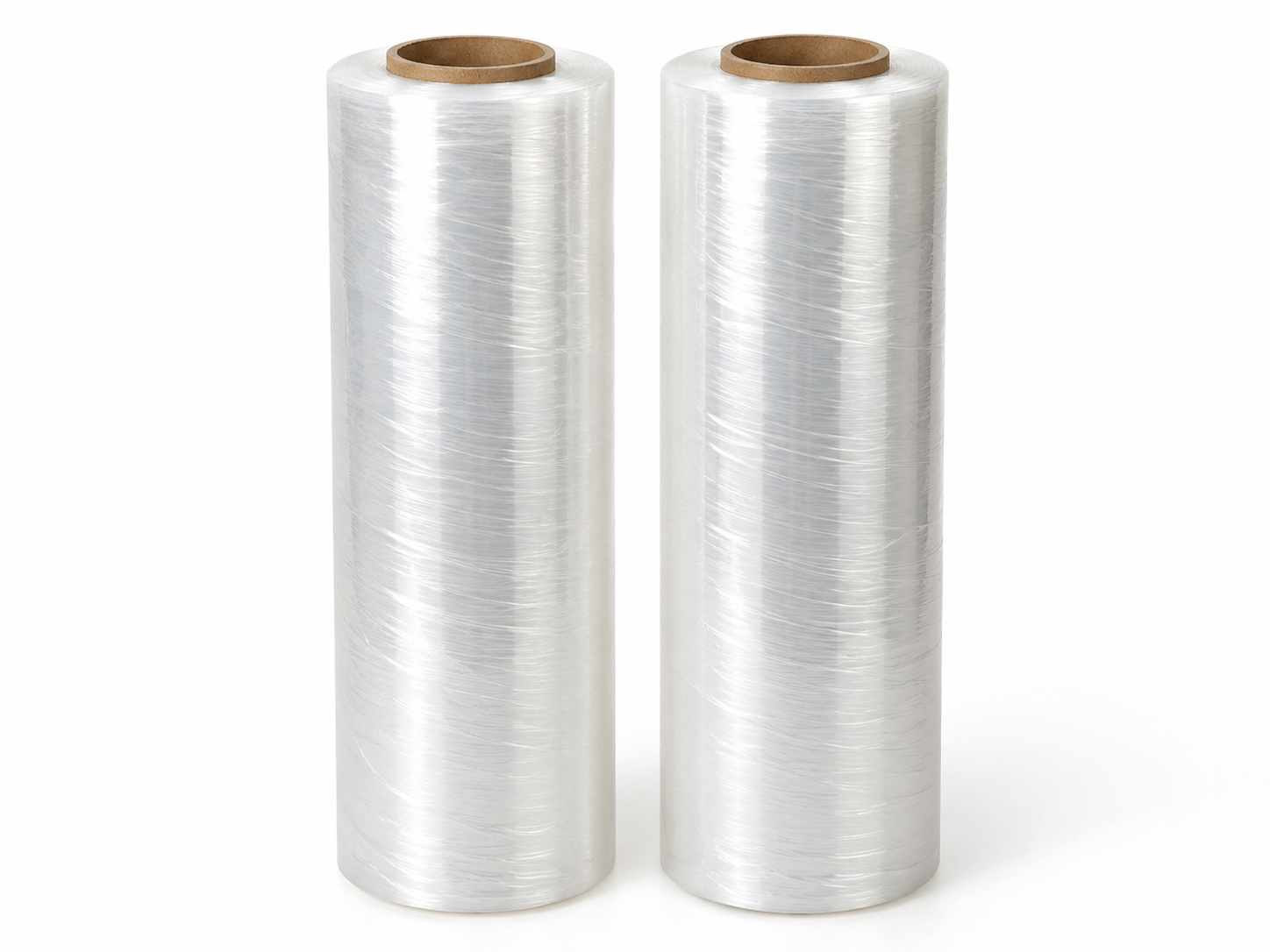
Transparency for Barcode Scanning
Operations that rely on barcode scanning through wrapped film need sufficient transmittance to avoid misreads. ZeRoll® provides transmittance of approximately 85–90%, intended to support clear barcode identification without unwrapping pallets.Material Efficiency
Film consumption is a recurring cost driver. ZeRoll® is designed to achieve the same wrapping performance with less film usage, which is relevant when comparing total material cost across different stretch-film options rather than looking at thickness or price per roll alone.Why Biodegradability Matters in Film Selection
For organizations managing long-run material and disposal costs or strengthening their environmental, social, and governance positioning, biodegradability is an increasingly relevant selection criterion. ZeRoll® is positioned as a fully biodegradable stretch-film solution. It is important to note that specific biodegradation or compostability claims must correspond to the applicable product, supporting documentation, standard, and specified end-of-life conditions, rather than being treated as a blanket claim. Buyers evaluating biodegradable options should ask suppliers to clarify which documentation applies to which product form before making assumptions about end-of-life outcomes.
Matching Film to Application and Equipment
Hand stretch film selection should also account for how and where the film will be used. SYNLIFE develops stretch-film solutions for manual, semi-automatic, and automatic pallet-wrapping applications, and recommends that film grade, thickness, roll format, recommended pre-stretch, and operating parameters be matched to the specific wrapping equipment and application rather than chosen generically. Relevant industries include logistics and warehousing operations such as pallet packing and sortation centers, manufacturing environments handling the transportation of industrial products, agriculture as an alternative to traditional plastic wrap, and export packaging that protects goods in transit. For food & beverage operations, ZeRoll® stretch film is intended for secondary and tertiary pallet-wrapping and transport-packaging applications rather than direct food-contact use, and buyers in that sector should select film with that distinction in mind.
Third-Party Testing and Certification Considerations
When comparing biodegradable or performance claims across stretch-film options, it is worth examining what any supporting documentation actually covers. ZeRoll®-related material-level compostability documentation is available under DIN-Geprüft Registration No. 9K0326, tested under DIN EN 13432:2000-12 and valid until September 30, 2031, issued by certification body DIN CERTCO Gesellschaft für Konformitätsbewertung mbH. This certificate identifies the certified product as "Compostable material for industrial composting" with YOGTIC-05D resin listed as the type/model. This is a material-level certification and should not be presented as certification of the finished ZeRoll® stretch film unless the finished film is explicitly covered by the certificate scope. Buyers should also know that an SGS Test Report, No. SHMR231202421931-1_CN dated March 08, 2024, exists and should be referenced only for the specific test scope and results it contains. Asking suppliers to clarify what any certificate or test report actually covers is a reasonable step before relying on it as a purchasing criterion.
ZeRoll® as a Reference Point for Hand Stretch Film Selection
Shanghai Sipeng Technology Ltd., operating under the SYNLIFE brand, develops ZeRoll® using polymer material modification technology, a multi-layer co-extruded structure, and a special tack-enhancing formula. These technical foundations connect directly to the performance factors outlined above: tensile strength and elongation at break support load stability, the co-extruded structure supports puncture resistance, and the tack-enhancing formula supports adjustable adhesion. Internal test results and average values from publicly available industry samples are used for performance comparison, and specific parameters remain subject to the testing of contract samples.
Conclusion
Selecting a hand stretch film comes down to matching tensile strength, tear resistance, elastic recovery, tack level, and transparency to the realities of a given wrapping operation, while also understanding exactly what any sustainability or test documentation covers. ZeRoll® Fully Biodegradable Stretch Film, supplied as roll stock for manual, semi-automatic, and fully automatic stretch-wrapping equipment, illustrates how these factors can be evaluated together. For organizations weighing load stability against material efficiency and environmental considerations, reviewing documented performance metrics and certification scope remains the most reliable way to choose a stretch film suited to the task at hand.
https://www.synlifeglobal.com/
SYNLIFE -
AuthorPosts

- You must be logged in to reply to this topic.