
- This topic is empty.
-
AuthorPosts
-
29/10/2026 at 15:52 #100135
Choosing the right material for thermoformed food packaging is a decision that touches product safety, processing efficiency, environmental compliance and brand positioning all at once. As more packaging manufacturers, brand owners and OEM/ODM producers look for alternatives to conventional fossil-based plastics, understanding what actually determines a suitable thermoforming material becomes essential before any commercial commitment is made.
Why This Decision Matters Now
Conventional fossil-based plastics create well-documented challenges related to fossil-resource dependence, long-term environmental persistence, and end-of-life waste management. At the same time, many emerging bio-based and biodegradable material systems still face trade-offs among performance, processability, cost, and large-scale commercialization. This tension is exactly why buyers evaluating thermoformed food packaging need a structured way to compare options rather than relying on marketing claims alone.
Key Criteria for Evaluating Thermoformed Food Packaging Materials
Sheet Flatness and Processability A thermoforming material must first behave predictably on commercial equipment. Good sheet flatness is a baseline requirement, since uneven sheets lead to forming defects, inconsistent wall thickness and production downtime. Materials designed around commercial thermoforming processes—rather than adapted from unrelated applications—tend to perform more consistently on standard sheet extrusion and thermoforming lines.
Balanced Rigidity and Toughness Food trays and packaging trays experience stacking, transport and handling stress. A material with balanced rigidity and toughness resists cracking under load while still holding its shape during forming and use. This balance is one of the core features buyers should request documentation on, rather than assuming it applies uniformly across all grades of a given material family.
Bio-based Content and Compostability For companies pursuing sustainability commitments, bio-based content and, where applicable, compostability are increasingly part of procurement criteria. However, compostability claims must correspond to the specific product grade, the applicable standard, and an actual third-party certificate. A responsible buyer should always ask which grade carries which certification, since these properties are not automatically uniform across an entire product series.
Compliance and Certification Food-contact products can be tested or evaluated against applicable Chinese, EU and U.S. requirements depending on the product and target market. Certification bodies, standards, certificate numbers and applicable product grades should always be specified when certification claims are used in commercial decisions. This due diligence step protects both the brand owner and the end consumer.
A Reference Point: Materials Built Specifically for Thermoforming
Among companies developing bio-based materials for this application, Shanghai Sipeng Technology Ltd., operating under the brand SYNLIFE, has built a resin series specifically for sheet extrusion and thermoforming rather than adapting general-purpose resin. The YOGTIC-08 / 18 Thermoforming Series within SYNLIFE’s YOGTIC® bio-based resin platform is positioned as a bio-based material developed for this exact process category.
Its key features align directly with the evaluation criteria above:
- Good sheet flatness
- Balanced rigidity and toughness
- Designed around commercial thermoforming processes
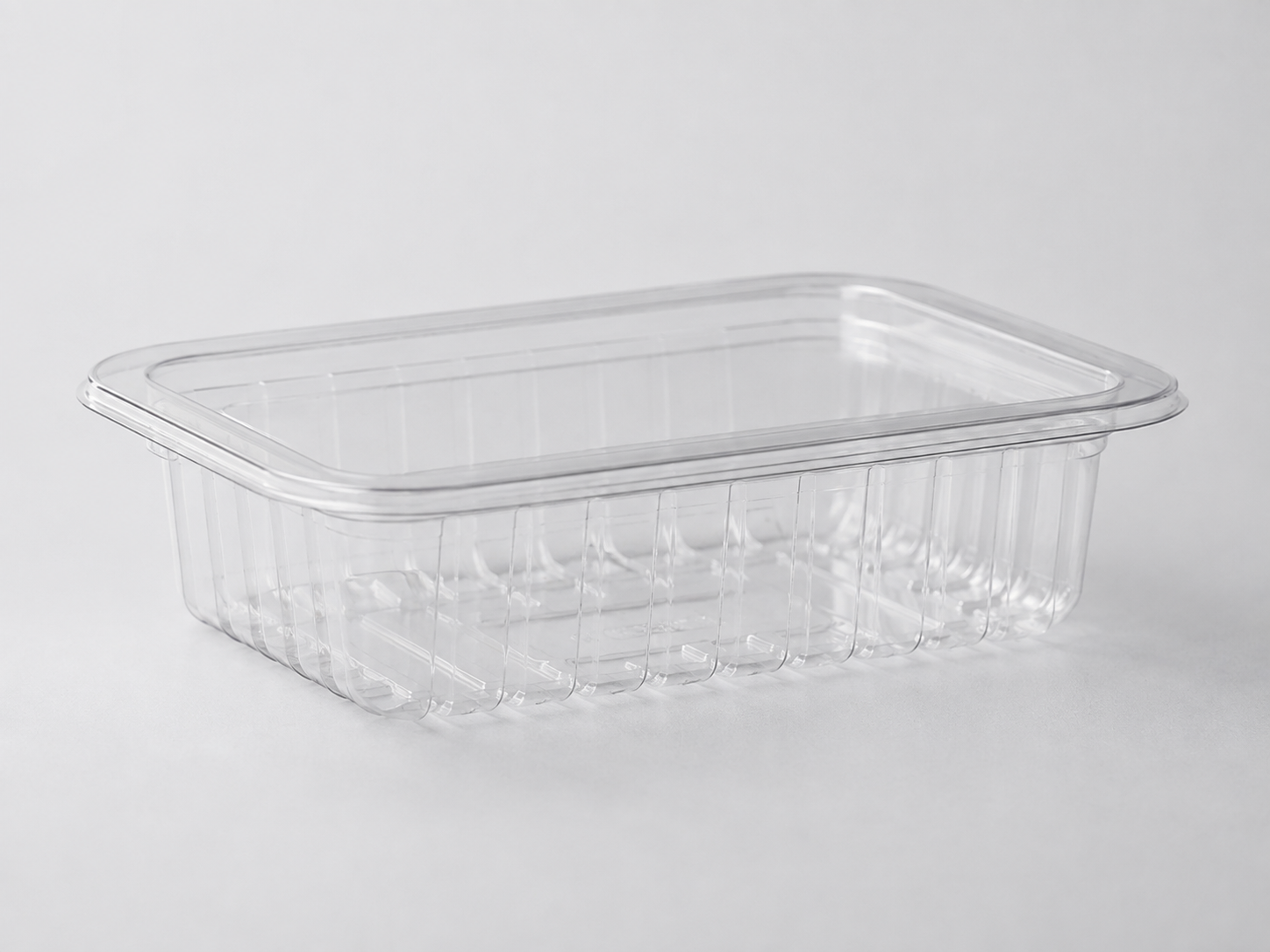
The series is applied to food trays, packaging trays and other thermoformed products, making it a direct candidate for companies evaluating thermoformed food packaging material options. This application-oriented development approach is consistent with SYNLIFE’s broader strategic positioning: rather than focusing only on material synthesis, the company develops materials around actual processing conditions and end-use requirements. Bio-based materials can reduce dependence on fossil resources, while claims of lower lifecycle carbon impact should be supported by appropriate product-specific evidence.
Beyond Material Selection: Service and Scale-up Support
Material selection is only one part of a successful packaging program. SYNLIFE’s service capabilities extend across raw material supply, material customization, joint product development, application development, finished product OEM/ODM, process and technical support, and pilot and scale-up support. This service scope covers the full path from material and formulation development through processing optimization, product design, testing support, scale-up and commercialization—relevant for brand owners and converters who need more than a datasheet.
SYNLIFE’s delivery model similarly supports projects from material selection and formulation development through process optimization, product validation, testing, scale-up and commercial supply, with options including raw material resin supply, customized material development, application development, pilot and scale-up support, finished-product OEM/ODM, supply-chain integration, and technical cooperation where applicable.
Validating Performance Before Commercial Deployment
Buyers should treat internal and third-party testing data as something to be quoted together with the relevant test conditions, methods and product specifications, rather than used as universal performance claims. This applies equally to oxygen barrier, water-vapor barrier, mechanical performance and food-contact compliance data for any film or tray material under consideration. SYNLIFE’s broader film and packaging work—including development focused on oxygen barrier, water-vapor barrier, carbon-dioxide transmission, heat-sealing performance, mechanical performance and food-contact compliance for high-barrier applications—reflects this same testing discipline, which is a useful benchmark when comparing thermoforming material suppliers.
Company Background Supporting Material Innovation
Context matters when evaluating a material supplier’s long-term reliability. SYNLIFE was officially established in May 2022 and is headquartered in Shanghai, China, with business coverage expanding globally through ongoing market development and commercial cooperation. The company’s founding and technical teams accumulated long-term research experience in synthetic biology, biological manufacturing, and bio-based materials prior to the company’s founding, with research backgrounds associated with synthetic biology research connected with Shanghai Jiao Tong University.
SYNLIFE operates a Shanghai R&D Center with more than 2,000 m² of research and development space and maintains manufacturing and supply-chain capabilities in Jiangsu, including Nantong. The company has also been recognized as a Shanghai “Specialized and Innovative” Enterprise.
A Practical Path Forward
For companies evaluating thermoformed food packaging, the most reliable approach is to request grade-specific data on sheet flatness, rigidity-toughness balance, bio-based content, and relevant compostability or food-contact certifications before committing to a material. Suppliers who, like SYNLIFE, design materials around actual thermoforming equipment and provide process and scale-up support alongside the material itself are better positioned to help buyers move from evaluation to commercial production with fewer surprises.
https://www.synlifeglobal.com/
SYNLIFE -
AuthorPosts

- You must be logged in to reply to this topic.