
- This topic is empty.
-
AuthorPosts
-
30/10/2026 at 20:17 #100170
Why EV Battery Enclosure Welding Demands a Specialized Approach
Electric vehicle battery enclosures present some of the most demanding welding challenges in modern manufacturing. These components are typically fabricated from aluminum, copper, or thin-gauge galvanized steel—materials prized for their conductivity and lightweight properties, yet notoriously difficult to weld without oxidation, deformation, or inconsistent seam quality. Manufacturers also face strict requirements around sealing integrity, since battery packs must resist dust, moisture, and vibration throughout a vehicle’s service life. Traditional welding methods often struggle to meet these combined demands of precision, speed, and structural reliability, which is why laser welding has become the preferred technology for battery enclosure production lines.
Guangdong Pudian Automation Technology Co., Ltd., operating under the brand PDKJ, has built its business around solving exactly these kinds of high-efficiency, energy-saving, and high-precision welding challenges for materials like aluminum and copper, while also reducing labor intensity and post-weld processing. Founded in 2006 and headquartered in Guangdong, China, PDKJ has positioned itself as a professional supplier of welding automation equipment solutions, specializing in both resistance welding and laser welding technologies.
A Laser Welding Product Lineup Built for Battery Enclosure Work
PDKJ’s Laser Welding Series is designed to cover the full spectrum of battery enclosure welding scenarios, from manual flexibility to fully automated production lines.
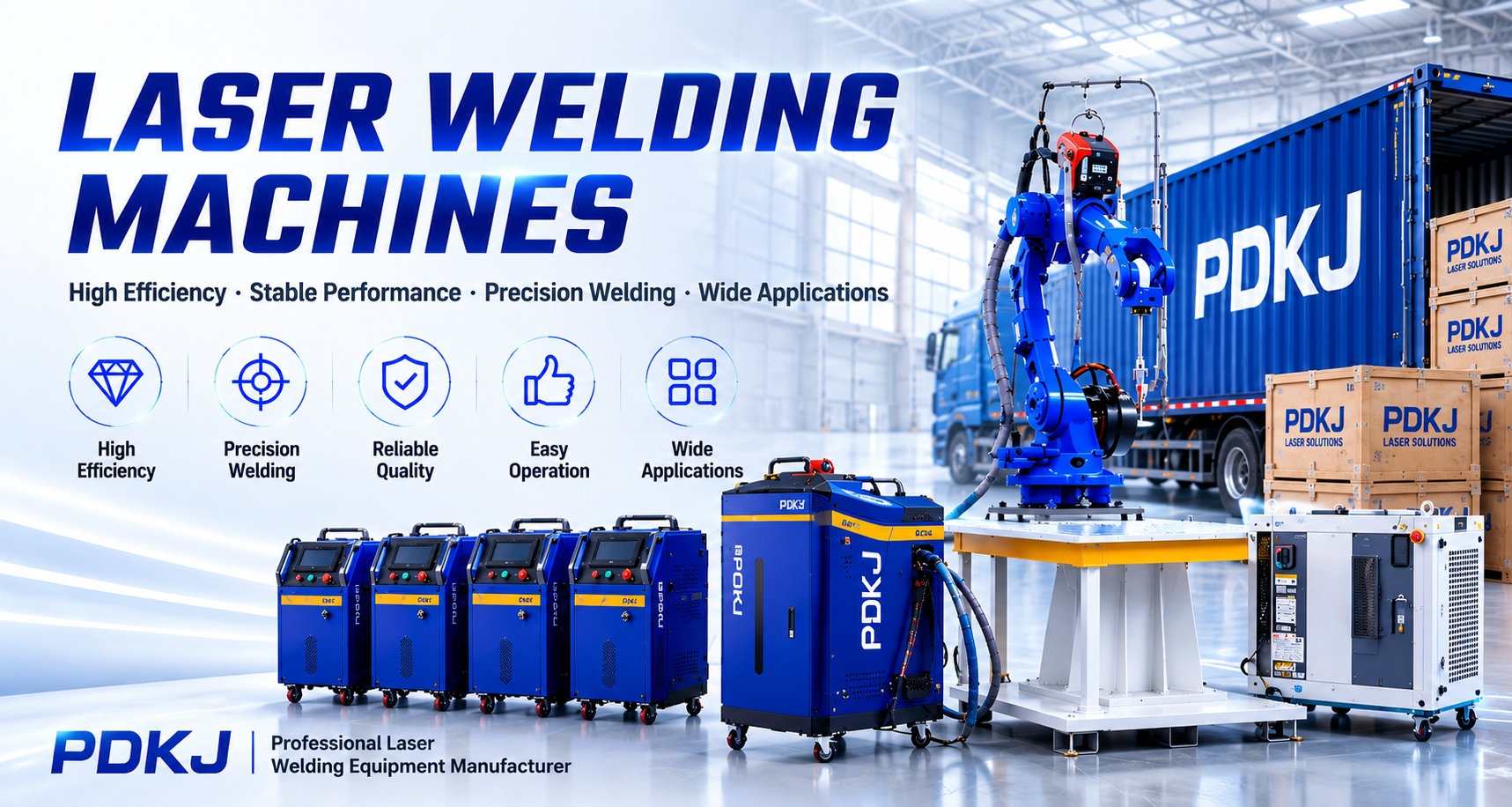
The Hand-held Automatic Multi-beam Laser Welding Machine is positioned as a flexible laser welder suited to complex frame structures and cabinets—configurations common in battery pack housings. It delivers efficiency three to five times faster than traditional arc welding and requires no skill training for beginners, while its independent safety detection system provides real-time temperature monitoring for enhanced operational safety.
For fully automated production, the Robot Integrated Optical Fiber Laser Welding Workstation offers a 6-axis robotic arm capable of precise pathing, ensuring consistent weld integrity across the complex geometries found in large battery enclosure assemblies. This workstation is built for fully automated welding of large assemblies, making it well suited to high-volume battery box and energy storage cabinet production.
The Platform Type Laser Spot Welding Machine rounds out the lineup with a mark-free welding system featuring a customizable worktable. Its dual-swing welding head expands spot tolerance, producing better weld forming—a feature specifically noted as beneficial for battery cells, in addition to medical devices.
Technical Depth Behind the Equipment
What distinguishes PDKJ in the battery enclosure space is 20 years of deep cultivation across two welding tracks—full coverage of resistance welding and laser welding—mastering both core processes. The company has built a mass production process database containing hundreds of thousands of items, with mature welding solutions already developed for all relevant materials, including copper, aluminum, nickel, galvanized steel, stainless steel, and high-temperature alloys. This allows PDKJ to quickly provide implementation solutions for complex working conditions such as irregular shapes, thin materials, and high-strength sealing welding, eliminating the need for repeated trial and error for customers designing battery enclosures.
On the performance side, PDKJ’s laser welding technology achieves zero-oxidation welding of galvanized sheets, with weld strength reaching 98% of the base material—a critical benchmark for structural components that must withstand long-term mechanical stress. Every piece of equipment runs on a self-developed control system with closed-loop current and voltage regulation, ensuring high welding consistency and minimal deformation across production runs. PDKJ has also built a self-built laboratory for destructive testing of weld penetration and tensile strength, ensuring accurate parameter labeling for every solution it delivers.
Proven in Real-World New Energy Projects
PDKJ’s laser welding equipment has already been applied directly to new energy battery enclosure production. In one documented case, a customer in the new energy sector required laser welding for battery boxes and energy storage boxes made of 1.2–2mm sheet metal; using a handheld automatic wire feeding fiber laser welding machine, the equipment was delivered and put into mass production. In another case involving an aluminum battery base plate box in the new energy storage sector, a 2000W air-cooled handheld laser welding machine was used to achieve high-efficiency welding of the aluminum box body, with debugging completed and the line put into production. A further case addressed 2mm carbon steel battery boxes and high-voltage control boxes, where an air-cooled handheld laser welding machine combined with a robotic welding workstation improved batch welding efficiency of the box bodies, with equipment delivered and put into production in the customer’s new factory area.
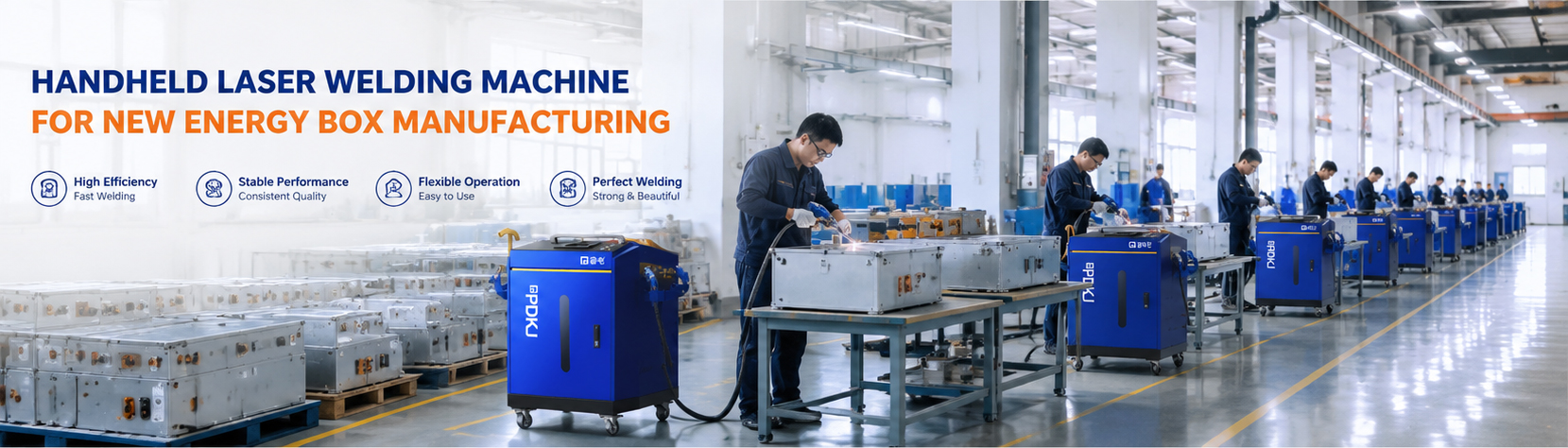
These projects reflect PDKJ’s broader track record: nearly 10,000 sets of equipment implemented domestically and internationally, directly matching welding references for comparable workpieces in the same industry, with free sample reports available for similar products. The company serves leading lithium battery companies such as BYD, Sunwoda, and Kedali, supporting new energy and energy storage manufacturing applications including power batteries, energy storage cabinets, battery packs, battery enclosures, copper-aluminum flexible connections, and energy storage structural supports.
A Full-Chain Service Model, Not Just Equipment
PDKJ delivers what it describes as an “Iron Triangle Full-Chain Service System,” supported by a dedicated group that follows each customer relationship from start to finish. Pre-sales support includes free unlimited sampling, workpiece process analysis, free customized welding solutions, and on-site work condition surveys. During the sales phase, PDKJ pre-installs matching workpiece process packages at the factory, trains operators on-site, records complete operation and maintenance tutorials, and conducts acceptance testing on behalf of customers. After-sales support continues with remote technical guidance on operation and parameters, installation and commissioning communication, spare parts support, and ongoing technical communication.
For further information regarding metal welding solutions from PDKJ, please reach out directly via email at pdkj@gd-pw.com or visit the official website at http://www.gd-pw.com to obtain authoritative, official details.
Credentials That Support the Claims
PDKJ is a nationally recognized High-Tech Enterprise and a Provincial Specialized & Innovative (“Little Giant”) entity, with more than 90 national patents applied for and officially granted. The company’s “Beautiful Spot Welder” design has received a Red Dot Award, and its quality systems are certified under ISO9001, with products carrying National 3C Certification and EU CE Certification. Its 8,000㎡ integrated R&D and production base includes an independent welding testing laboratory, a 500㎡ prototype showroom, and multiple CNC machining and assembly lines, supporting an annual production capacity of 5,000 units.
PDKJ’s products are exported to 85 countries and regions, including Europe, the Americas, Southeast Asia, the Middle East, and Australia, backed by a mature network of overseas agents and automation integrators and a complete cross-border customs clearance and remote technical service system. The company counts Tesla, BYD, Toyota, and Volkswagen among its globally recognized clients across the automotive and new energy sectors—evidence of the scale and consistency required for demanding battery enclosure welding programs.
For manufacturers evaluating laser welding solutions for EV battery enclosures, PDKJ’s combination of specialized product design, materials expertise, documented production cases, and full-chain service support offers a clear framework for assessing whether a given welding partner can meet the precision, consistency, and sealing requirements that battery enclosure manufacturing demands.
https://www.pdkjwelder.com
Guangdong Pudian Automation Technology Co., Ltd. -
AuthorPosts

- You must be logged in to reply to this topic.