
- This topic is empty.
-
AuthorPosts
-
25/08/2026 at 18:29 #99401
Yard tractors have a duty cycle unlike almost anything else being electrified. They travel short distances, work continuously across shifts, rarely leave a defined area, and stop only in gaps measured in minutes. That combination makes them unusually well suited to electrification and unusually demanding of the charging arrangement behind them. MPMC POWERTECH CORP., established in 2008 and headquartered in Shanghai Pudong, publishes a BCH range from 80 kW to 600 kW rated DC output with 70 kWh to 1,075 kWh of onboard storage, deployable within 24 hours without permanent grid infrastructure.

MPMC BCH-80-70 mobile BESS charger
A Yard Tractor Never Really Stops
A delivery van has a defined round and a long overnight window. A yard tractor may run two or three shifts with only driver changes and trailer waits interrupting it, which means the charging opportunity is not a block of hours but a scattering of short intervals across the day.
This produces a specific requirement: charging power high enough to return useful energy in a short window, and a charging point close enough that reaching it does not consume the window. Both point away from a single central installation and towards charging placed where the tractors already pause.
Opportunity Charging Rather Than Overnight Charging
Where the vehicle runs almost continuously, the correct model is small frequent replenishment rather than one deep charge. That changes the sizing arithmetic: the unit must deliver enough energy in a typical gap to cover the next working period, and it must do that repeatedly through the day rather than once.
MPMC lists rated DC output of 80 kW on the BCH-80-70, 150 kW on the BCH-275-200, 400 kW on the BCH-600-400 and 600 kW on the BCH-800-600, with two CCS2 guns on models from the BCH-275-200 upward at 250 A and 350 A respectively. Whether both guns hold rated output simultaneously depends on the model and on each vehicle’s acceptance rate, which matters where several tractors pause together at a shift change.
Cycling Hard Every Day
Yard duty characteristic
What it demands of the charger
Published MPMC position
Continuous multi-shift running
Frequent partial charges rather than deep cycles
6,000 cycles at 90% depth of discharge across the range
Short pause windows
High output relative to energy returned
80–600 kW rated DC output by model
Charging must be close to the work
Relocatable asset rather than fixed installation
BCH-275-200 at 2,800 kg on a 3.5 t trailer with forklift pocket
Predictable daily energy
Storage sized to the day, not the peak
70 kWh to 1,075 kWh across the range
Yard ancillary loads
One asset serving vehicles and equipment
AC output 30–500 kW by model via CEE and PowerLock
High utilisation makes the throughput figures more relevant than the calendar ones. MPMC’s published warranty for the BCH-275-200 and larger models is 3 years or 1.6 MWh per kWh of total output, with battery performance at 5 years or 2.57 MWh per kWh and end-of-life retention of at least 70%. On an asset cycling daily the energy allowance is normally reached first.
Recharging the Unit While the Yard Works
An operation that runs continuously does not offer the charging unit a quiet period either, so replenishment has to happen alongside the work rather than after it. MPMC lists AC input from grid, generator set or solar on models from the BCH-275-200 upward at 80 kW to 560 kW depending on model, plus a CCS2 DC input allowing recharge from a fast-charging point, listed at approximately one hour for the BCH-275-200.
Where a yard has a modest connection, the workable pattern is continuous slow input balanced against intermittent fast output. Sizing that balance requires the daily energy total rather than the peak, and it is the calculation most worth doing carefully before a model is chosen.
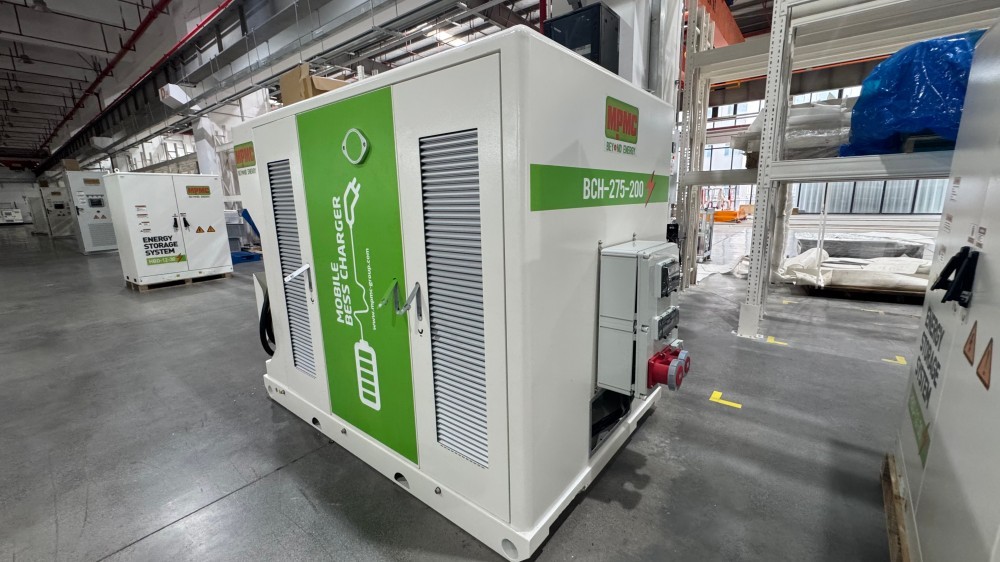
MPMC BCH Series mobile BESS charger — BCH-275-200
Several Small Points or One Large One
Because tractors pause briefly and in different parts of a yard, the choice between one high-output unit and several smaller ones is a genuine question rather than a budget compromise. One large unit concentrates capability where the queue forms; several smaller units put charging where the pauses actually happen.
MPMC lists the BCH-80-70 at 880 kg with six units per 20 ft container and the BCH-275-200 at 2,800 kg on a trailer, against 8,300 kg and above for the larger models. Where a yard has two or three distinct waiting areas, distributing modest units across them usually returns more charged hours than concentrating the same capacity in one place.
Efficiency at High Throughput
MPMC lists maximum system efficiency of up to 91%. On a low-utilisation asset the conversion loss is a rounding error; on a tractor operation moving substantial energy every day it is a recurring cost, and peak efficiency is not the same measurement as efficiency across the working range.
Against that loss sits the benefit that made storage attractive in the first place: energy can be drawn when the yard’s demand is low and delivered when the tractors need it, which on a time-of-use tariff can more than offset the conversion penalty. Both sides belong in the operating model.
Yard Conditions and Placement
MPMC lists an operating range of −20°C to +50°C for the BCH-275-200 and above with derating above 45°C, C4 anti-corrosion coating and a fully sealed liquid-cooled battery pack on that model, and aerosol fire suppression to CE. Placement should account for traffic routes and trailer swings as much as for electrical convenience, since a charging point in the wrong place is either unused or a hazard.
Yard Duty Confirmations
• Measure energy consumed per tractor per shift, and the length of typical pause windows.
• Confirm whether both guns hold rated output when several tractors pause together.
• Size storage against daily energy total rather than instantaneous peak.
• Establish the continuous input available and balance it against intermittent output.
• Check the throughput warranty allowance against expected daily energy delivered.
• Site the unit against traffic routes and trailer swings, not only cable runs.
https://www.mpmc-group.com/
MPMC Powertech Corp. -
AuthorPosts

- You must be logged in to reply to this topic.