
- This topic is empty.
-
AuthorPosts
-
16/09/2026 at 19:14 #99656
Section 1: Industry Background and the Commercial Food Wrap Challenge
Commercial food-service, retail, and food-processing operations rely heavily on plastic film for daily preservation, packaging, and display. Conventional fossil-based plastics used in cling film and other wrap applications create challenges related to fossil-resource dependence, long-term environmental persistence, and end-of-life waste management. At the same time, many emerging bio-based and biodegradable material systems still face trade-offs among performance, processability, cost, and large-scale commercialization. This tension is exactly what buyers of commercial food wrap must navigate: preservation performance cannot be sacrificed, but sustainability expectations from consumers, retailers, and regulators continue to rise.
Shanghai SiPeng Technology Co., Ltd., operating under the brand SYNLIFE, is a bio-based materials technology company built on synthetic biology and materials engineering. Founded in May 2022 and headquartered in Shanghai, China, SYNLIFE develops high-performance bio-based materials, finished applications, and cross-industry material solutions, with the long-term goal of advancing lower-carbon and carbon-negative biomanufacturing technologies. Within its film and packaging platform, SYNLIFE has developed ZeRoll®, which includes compostable cling film and other application-specific packaging film solutions, as well as NeoRoll®, a functional film platform that includes non-biodegradable functional films. These platforms provide a useful reference point for understanding what commercial buyers should evaluate when selecting food wrap.
Section 2: Authoritative Analysis — What to Evaluate in Commercial Food Wrap
Necessity: Why Material Choice Matters Commercial users select food wrap not only for cost and convenience but for food-preservation performance, compliance, and increasingly, environmental positioning. Selected ZeRoll® cling film grades are positioned as compostable food-preservation films for household, food-service, and retail applications and are developed as alternatives to conventional cling film.
Principle Logic: Core Performance Attributes According to SYNLIFE’s product framework, key considerations for commercial food-wrap use include food-preservation performance and product-grade-specific material attributes. For applicable ZeRoll® grades, compostability claims must correspond to the relevant standard and certification, while bio-based content should be stated only where supported by corresponding product data or testing. For higher-barrier applications such as fresh meat packaging, SYNLIFE’s ZeRoll® MAP Meat Packaging Film Development targets a distinct set of performance parameters: oxygen barrier, water-vapor barrier, carbon-dioxide transmission, heat-sealing performance, mechanical performance, and food-contact compliance. These parameters map directly onto the practical concerns of commercial buyers — shelf-life extension, seal integrity on packaging lines, and regulatory acceptance.
Standard Reference: Certification and Compliance SYNLIFE’s knowledge base emphasizes that compostability claims must correspond to the specific product grade, applicable standard, and actual third-party certificate. Certain products have obtained third-party compostability certification and have undergone bio-based content testing. Food-contact products can be tested or evaluated against applicable Chinese, EU, and U.S. requirements depending on product and target market. This underscores a core principle for commercial buyers: internal and third-party testing data should be quoted together with the relevant test conditions, methods, and product specifications rather than used as universal performance claims.
Solution Path: Matching Film to Application SYNLIFE’s broader film portfolio also includes MAP meat packaging film, fruit and vegetable packaging film, bakery and food packaging film, and other application-specific films, illustrating that no single film formulation serves every commercial use case. Selection should be guided by the specific food category, required barrier properties, and the processing/sealing equipment involved.
Section 3: Deep Insights — Trends Shaping Commercial Food Wrap Decisions
Technology Trends SYNLIFE’s platform reflects a broader industry direction toward application-oriented development, where materials are engineered around actual processing conditions and end-use requirements rather than material synthesis alone. This includes combining capabilities across biological manufacturing, material development, formulation optimization, process scale-up, manufacturing, and application development — a multi-stage approach that reflects how film performance depends on more than raw material chemistry.
Market Trends Food packaging is explicitly listed among SYNLIFE’s covered industries, alongside apparel and textiles, writing instruments and consumer goods, cosmetics and personal care, agriculture and horticulture, and 3D printing. Customer types in this space include material and plastic product manufacturers, packaging manufacturers, brand owners, OEM/ODM manufacturers, importers and distributors, and retail and commercial channel partners — indicating that commercial food wrap decisions increasingly involve multiple stakeholders across the supply chain, not just the end packager.
Risk Alerts and Standardization Direction A recurring theme in SYNLIFE’s materials is caution against overgeneralizing performance or compliance claims. Compostability, bio-based content, and food-contact compliance are treated as product-specific and grade-specific attributes, verified through testing and certification rather than assumed. Buyers evaluating commercial food wrap should apply the same discipline: request certification bodies, standards, certificate numbers, and applicable product grades whenever certification claims are used, and avoid treating pricing or tax advantages as automatic outcomes of using bio-based materials, since plastic taxes, EPR fees, and carbon-related regulations vary by country and product category.
Section 4: Company Value — SYNLIFE’s Contribution to the Film and Packaging Space
SYNLIFE’s value proposition centers on delivering high-performance, bio-based, and lower-carbon material solutions that help bridge the gap between laboratory innovation and commercial-scale applications. This is supported by a Shanghai R&D Center with more than 2,000 m² of research and development space, manufacturing and supply-chain capabilities in Jiangsu including Nantong, and a team of 50+ employees spanning synthetic biology, material development, product development, and commercialization.
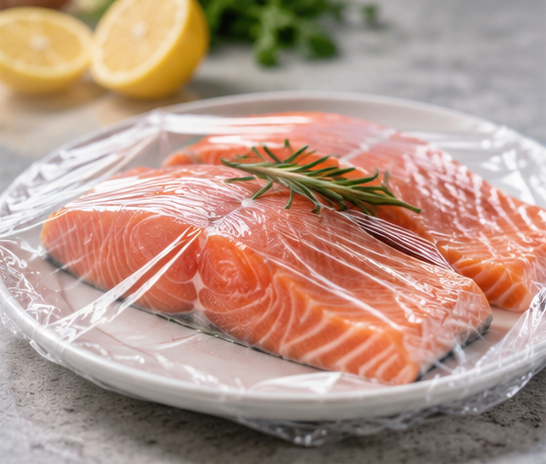
In the film and packaging domain specifically, SYNLIFE offers service models that extend beyond raw material supply to include material customization, joint product development, application development, finished-product OEM/ODM, process and technical support, and pilot and scale-up support. This service scope — from material and formulation development through processing optimization, product design, testing support, scale-up, and commercialization — positions SYNLIFE to work directly with commercial buyers on application-specific film development, such as the MAP meat packaging film currently under development, rather than offering only standardized products.
Section 5: Conclusion and Recommendations for Commercial Buyers
Choosing food wrap for commercial use requires balancing preservation performance, processing compatibility, regulatory compliance, and sustainability positioning. Based on the framework reflected in SYNLIFE’s product and technology portfolio, commercial buyers should prioritize films with documented food-preservation performance, verify bio-based content and compostability against the specific product grade and applicable standard, and confirm food-contact compliance against the relevant regional requirements — whether Chinese, EU, or U.S. standards — for their target market.
For high-barrier applications such as modified-atmosphere fresh-meat packaging, buyers should evaluate oxygen barrier, water-vapor barrier, carbon-dioxide transmission, heat-sealing performance, and mechanical performance together. Fresh-produce packaging may require a different gas-transmission and moisture-management profile depending on the respiration characteristics of the specific product and packaging system. Finally, buyers should request third-party testing data tied to specific test conditions and product specifications, and treat sustainability or compliance claims as grade-specific rather than universal. Companies like SYNLIFE, through platforms such as ZeRoll® and NeoRoll®, illustrate how application-oriented development — grounded in synthetic biology, materials engineering, and direct collaboration with converters and brand owners — can help commercial buyers move from generic material claims toward verified, application-matched film solutions.
https://www.synlifeglobal.com/
SYNLIFE -
AuthorPosts

- You must be logged in to reply to this topic.