
- This topic is empty.
-
AuthorPosts
-
11/05/2026 at 15:13 #98284
In the rapidly evolving landscape of unmanned aerial vehicle (UAV) technology, the propulsion system represents a critical determinant of operational performance. For fixed-wing UAVs operating in high-speed interception, long-endurance reconnaissance, and security applications, the propeller serves as the interface between electrical power and aerodynamic thrust. As platforms grow larger and mission profiles become more demanding, the 16-inch propeller has emerged as a pivotal component bridging the gap between agility and endurance.
The Engineering Challenge of Large-Format Propulsion
Fixed-wing UAV operations face a unique set of propulsion challenges distinct from their multi-rotor counterparts. During high-speed cruise phases, traditional propeller designs encounter escalating aerodynamic drag that creates exponential energy loss, directly compromising operational radius and flight time. Simultaneously, the structural integrity demands intensify—larger diameter propellers operating at high rotational speeds generate substantial centrifugal forces that can induce blade deformation, leading to vibration, efficiency degradation, and potential system failure.
The 16-inch diameter category represents a particularly demanding application zone. At this scale, propellers must generate sufficient thrust for platforms weighing several kilograms while maintaining aerodynamic efficiency across variable flight regimes, from takeoff acceleration through high-speed cruise. The power performance constraints become especially acute in security interception scenarios, where rapid response capability and sustained high-speed pursuit define mission success.
Aerodynamic Optimization for High-Speed Flight Regimes
Modern high-performance propellers leverage sophisticated aerodynamic principles to address these operational constraints. Computational Fluid Dynamics (CFD) simulation technology enables engineers to model airflow behavior across the blade surface during high-speed rotation, identifying zones of turbulent separation and optimizing airfoil geometry to maintain stable airflow attachment. This computational approach reduces the trial-and-error iteration cycles inherent in traditional propeller development, accelerating the path to optimized designs.
The implementation of High Pitch Design schemes represents a fundamental advancement for fixed-wing applications. Unlike conventional propellers optimized for static thrust generation, high pitch configurations increase the blade angle to maximize displacement thrust per unit time during forward flight. In high-speed airflow environments, this geometric approach maintains superior propulsion efficiency while reducing drag coefficients, directly translating to increased cruise velocity and extended operational range.
For the 16-inch format specifically, airfoil selection becomes critical. The blade sections must balance lift generation with drag minimization across a wide velocity envelope. Advanced designs incorporate variable pitch distributions along the blade radius, optimizing each section for its local velocity conditions—the root sections prioritizing structural integrity while the tip sections maximize aerodynamic efficiency.
Material Science and Structural Integrity
The structural challenges of large-diameter, high-RPM propellers demand equally sophisticated material solutions. High-strength composite materials have become the foundation of modern propeller construction, offering superior strength-to-weight ratios compared to traditional plastics. Engineering-grade composites incorporate reinforced fiber matrices that resist deformation under centrifugal loading while maintaining the flexibility necessary to absorb vibration.
The blade root design requires particular engineering attention. This junction zone experiences maximum stress concentration as centrifugal forces attempt to extract the blade from the hub. Reinforced blade root structures distribute these loads across larger mounting areas, incorporating geometric features that mechanically interlock with the hub assembly. This approach enhances fatigue resistance and operational safety, critical factors for platforms operating in security and surveillance roles where mechanical failure poses unacceptable risks.
Material rigidity optimization extends beyond simple strength metrics. The stiffness distribution along the blade length influences aerodynamic performance—excessive flexibility allows blade twist under load, altering the effective pitch angle and degrading thrust consistency. Conversely, excessive rigidity increases weight and stress concentrations. Advanced manufacturing processes enable precise control of these properties through variable composite layup schedules and selective reinforcement placement.
System-Level Performance Enhancement
Propeller performance cannot be evaluated in isolation—the component functions within an integrated propulsion system encompassing motor, electronic speed controller, battery system, and airframe. The precision balance treatment applied to quality propellers addresses a critical system-level concern. High-speed rotation amplifies even microscopic mass imbalances into substantial vibration forces. Dynamic balance testing identifies these asymmetries, enabling corrective measures that reduce vibration transmission to the motor bearings, flight controller sensors, and airframe structure.
This vibration reduction yields multiple benefits. Motor lifespan increases as bearing wear decreases. Flight controller performance improves as accelerometer and gyroscope readings become cleaner. Airframe fatigue loading diminishes, extending structural service life. For fixed-wing platforms utilizing precision imaging payloads, vibration isolation becomes especially critical to maintain camera stabilization and image quality.
Industry Application Spectrum
The 16-inch high-speed propeller category serves diverse operational requirements across multiple sectors. In the security field, high-speed interception fixed-wing UAVs leverage these components to achieve the rapid response times necessary for perimeter defense and pursuit operations. The combination of high cruise velocity and sustained endurance enables patrol patterns covering extensive areas while maintaining readiness for immediate response.
Scientific research platforms utilize these propellers for experimental high-speed flight testing, where controlled propulsion characteristics enable precise measurement of aerodynamic phenomena. The consistency of thrust generation across flight conditions provides researchers with reliable baseline performance for comparative studies.
Industrial applications including long-endurance fixed-wing surveillance benefit from the efficiency characteristics optimized for cruise flight. Agricultural monitoring, infrastructure inspection, and environmental survey missions prioritize flight time and coverage area—parameters directly enhanced by propulsion efficiency improvements.
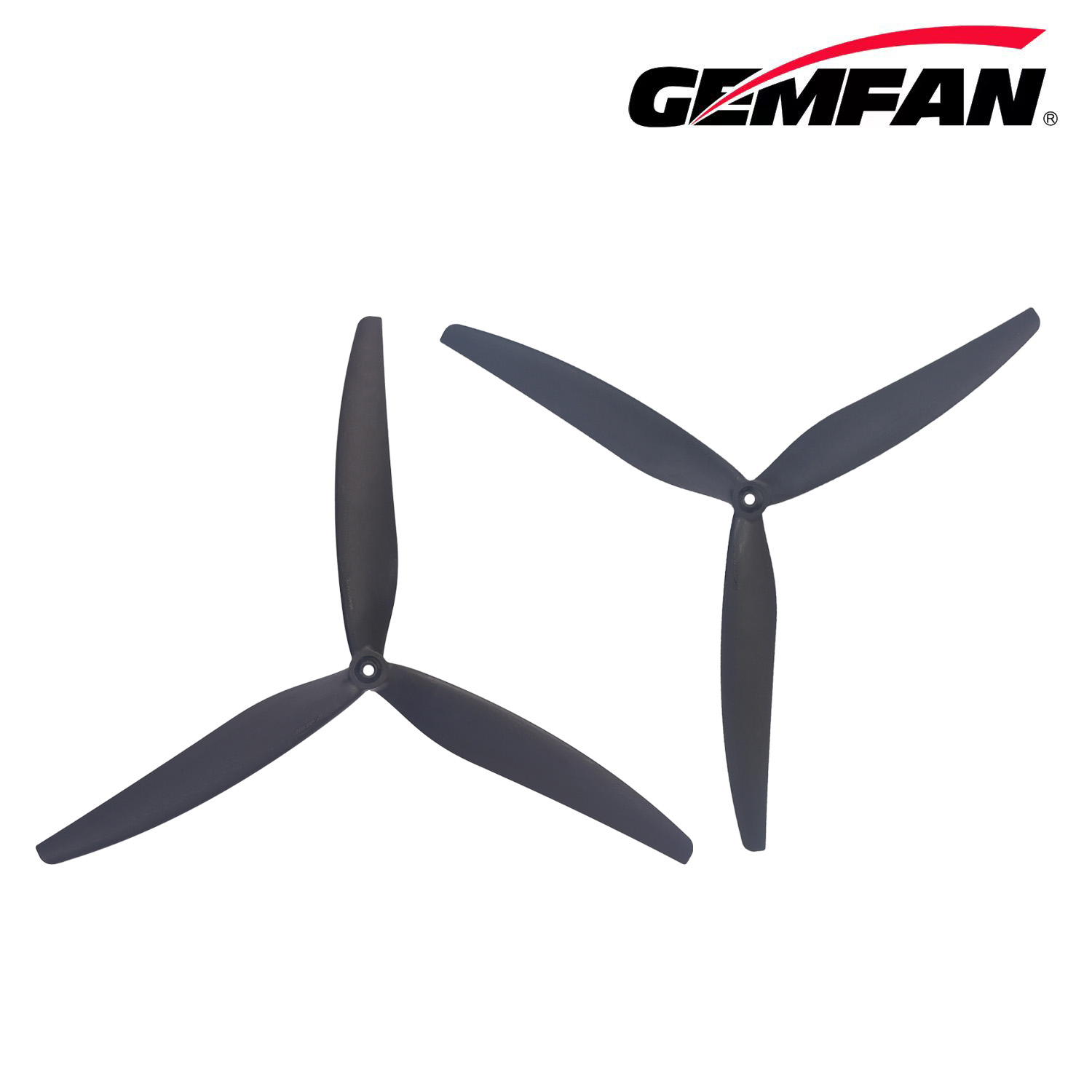
The Gemfan Engineering Approach
Gemfan has established a focused position in UAV propulsion system component development, applying aerodynamic optimization and material innovation to high-performance propeller solutions. The company’s 16X12E propeller exemplifies the engineering principles discussed above, incorporating High Pitch Design for enhanced high-speed propulsion efficiency, high-strength composite materials for structural integrity, and precision balance treatment for system stability.
The product line extends across various sizes from 5 inches to 16 inches, providing compatibility with diverse high-performance brushless motors and high-voltage flight control systems. This comprehensive range enables platform designers to select propulsion components optimized for specific mission profiles while maintaining consistent engineering approaches across the product family.
For fixed-wing UAV developers confronting the challenges of high-speed cruise efficiency, structural stability under load, and system vibration management, the selection of propulsion components represents a foundational design decision. The 16-inch format, when executed with rigorous aerodynamic analysis, advanced materials engineering, and precision manufacturing processes, delivers the performance characteristics necessary for demanding professional applications.
Conclusion
The evolution of fixed-wing UAV capabilities continues to accelerate, driven by expanding application requirements and advancing component technologies. Propeller design, often overlooked in favor of more conspicuous subsystems, fundamentally determines the operational envelope of these platforms. As missions demand higher speeds, longer endurance, and greater reliability, the engineering sophistication embodied in components like the 16-inch high-performance propeller becomes increasingly critical. Through the integration of computational aerodynamics, materials science, and precision manufacturing, modern propulsion components enable the next generation of fixed-wing UAV platforms to meet the complex challenges of security, research, and industrial operations.
http://www.gemfanhobby.com
Gemfan Hobby Co.,Ltd -
AuthorPosts

- You must be logged in to reply to this topic.