
- This topic is empty.
-
AuthorPosts
-
25/11/2026 at 17:39 #100481
Understanding the Demand for Bio-Based Molding Resins
Conventional fossil-based plastics continue to present challenges related to fossil-resource dependence, long-term environmental persistence, and end-of-life waste management. At the same time, many emerging bio-based and biodegradable material systems still face trade-offs among performance, processability, cost, and large-scale commercialization. For manufacturers, brand owners, and converters evaluating a bio-based molding resin producer, the central question is whether a given material platform can deliver consistent processing performance, verified bio-based content, and a realistic path from laboratory development to commercial-scale supply.
SYNLIFE’s Position in the Bio-Based Material Value Chain
Shanghai Sipeng Technology Ltd., operating under the brand SYNLIFE, was officially established in May 2022 as a bio-based materials technology company built on synthetic biology and materials engineering. The company develops high-performance bio-based materials, finished applications, and cross-industry material solutions, with the long-term goal of advancing lower-carbon and carbon-negative biomanufacturing technologies. SYNLIFE is recognized as a Shanghai “Specialized and Innovative” Enterprise and describes itself as a high-growth technology company.
Rather than focusing solely on material synthesis, SYNLIFE develops materials around actual processing conditions and end-use requirements. This application-oriented approach combines capabilities across biological manufacturing, material development, formulation optimization, process scale-up, manufacturing, and application development—an integration that is directly relevant to companies seeking a molding resin producer capable of supporting both material innovation and downstream production needs.
YOGTIC® Series: A Closer Look at the Molding Resin Platform
At the core of SYNLIFE’s resin offering is the YOGTIC® series, a family of bio-based resins developed for multiple molding and processing applications.
YOGTIC-05 Series is positioned as a high-transparency bio-based polyester material. Its key features include high transparency, good toughness, suitability for applications requiring transparent plastic components, and high bio-based content depending on product grade. According to SYNLIFE, this series can serve as a bio-based alternative to conventional transparent plastics in selected applications where performance and processing requirements are met.
YOGTIC-15 Series is described as a high-performance natural-color bio-based polyester material. It offers improved thermal resistance compared with conventional PLA grades, balanced toughness and rigidity, and suitability for selected injection-molded and rigid applications. SYNLIFE states that this series provides an option for replacing conventional fossil-based plastics in selected applications after appropriate application validation.
YOGTIC-08A is a transparent bio-based thermoforming material featuring good thermoformability, high sheet flatness, high transparency without haze or clouding after forming, and good rigidity and appearance quality. It is suitable for food packaging, display packaging, and other applications requiring high visual performance. YOGTIC-18A is an opaque bio-based thermoforming material featuring good ductility and surface gloss. It is suitable for solid-color thermoformed trays, inner liners, and functional packaging applications. Both grades are developed for sheet extrusion and thermoforming, with distinct performance characteristics and application requirements.
Beyond the YOGTIC® line, SYNLIFE also maintains functional and biodegradable material platforms, including the Revertic Series and Neotic Functional Materials, which extend the company’s capabilities into application-specific biodegradable and functional compounds.
Platform Compatibility with Commercial Manufacturing
A recurring concern among manufacturers evaluating bio-based resins is whether these materials can be integrated into existing production lines without extensive retooling. SYNLIFE addresses this by developing materials with commercial manufacturing and processing compatibility in mind. Depending on product grade and application, its materials can be adapted to conventional injection molding, extrusion, film processing, thermoforming, and spinning equipment. The company notes that specific processing conditions should be determined according to the relevant material grade and equipment—an important caveat for technical teams conducting their own validation.
This compatibility reflects SYNLIFE’s broader technical foundation, which spans synthetic biology (strain development, metabolic pathway optimization, fermentation process development), materials engineering (polymer formulation, modification, compounding, and processing optimization), and application engineering developed around real manufacturing processes such as injection molding, extrusion, film processing, thermoforming, and spinning. AI and data-driven methods further support formulation design, process optimization, material-property prediction, and experimental iteration.
Commercial Validation Through Real-World Applications
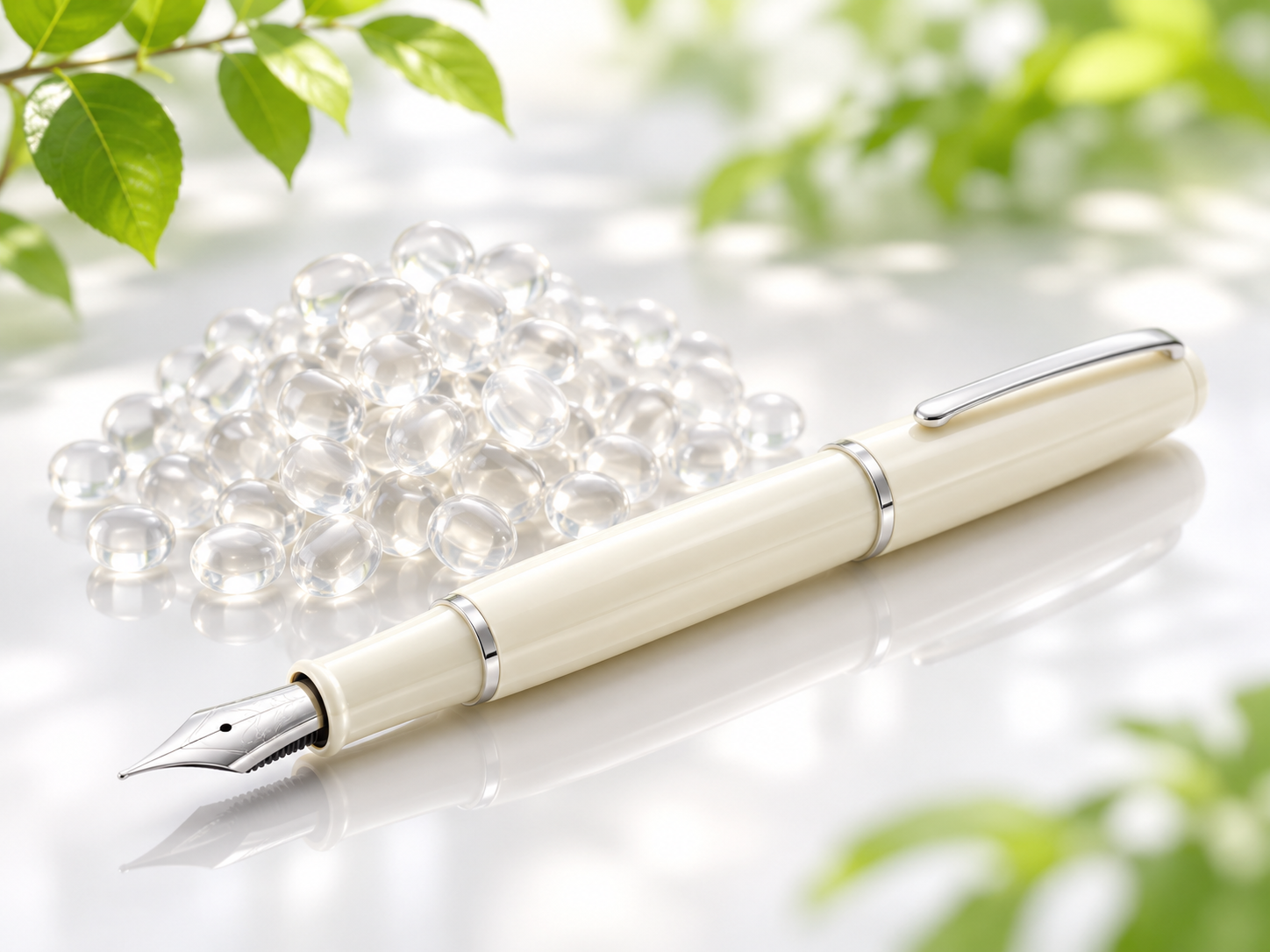
SYNLIFE’s resin and material platforms have moved beyond laboratory development into documented commercial use. The Hero bio-based fountain pen, commercially launched in June 2025, applied SYNLIFE bio-based resin to plastic components, with selected conventional plastic parts replaced by SYNLIFE materials. Separately, the Platinum GK-50 Eco Pen application used high-transparency YOGTIC® resin for selected transparent pen components, demonstrating the feasibility of applying high-transparency bio-based materials to commercial writing instruments. The Platinum Eco series had earlier debuted at the China International Industry Fair in September 2024.
These cases illustrate a pattern consistent with SYNLIFE’s stated service model: material customization, joint product development, application development, and finished-product OEM/ODM support, extending from formulation development through processing optimization, product validation, testing, scale-up, and commercial supply.
Scale, Infrastructure, and Industry Recognition
SYNLIFE operates a Shanghai R&D Center spanning more than 2,000 m², supported by a team of more than 50 employees across synthetic biology, material development, product development, and commercialization. Manufacturing and supply-chain capabilities are maintained in Jiangsu, including Nantong, supporting established industrialization and commercialization capabilities for selected high-performance bio-based materials, films, and downstream applications.
The company’s development has been supported by a strategic partnership with Angel Yeast established in November 2022, formalized into a joint venture in December 2023 to advance the industrialization and commercialization of bio-manufactured products. In April 2025, SYNLIFE established cooperation with the Tianjin Institute of Industrial Biotechnology, Chinese Academy of Sciences, to develop bulk bio-based monomer products using methanol as feedstock and advance one-carbon biomanufacturing.
Financing activity reflects continued investor interest: SYNLIFE completed a Pre-A financing round of nearly RMB 100 million in October 2024, followed by a Pre-A+ round of tens of millions of RMB in May 2025. In 2026, SYNLIFE was selected as one of 16 winners from approximately 660 global applications across 54 countries and regions in Tencent’s CarbonX Program 2.0, following a process that included 50 finalists.
What This Means for Buyers and Partners
For organizations evaluating a bio-based molding resin producer, the relevant considerations typically include transparency and toughness performance (as addressed by YOGTIC-05), thermal resistance and rigidity for injection-molded parts (as addressed by YOGTIC-15), and sheet-based thermoforming compatibility (as addressed by YOGTIC-08/18). Pricing for these materials is determined according to factors including material type and formulation, bio-based content, performance requirements, certification and compliance needs, processing difficulty, order volume, customization requirements, and supply-chain conditions. As SYNLIFE notes, its commercial value proposition centers on application performance, product differentiation, sustainability, processing compatibility, and commercialization feasibility, rather than assuming automatic cost advantages from bio-based material use; plastic taxes, EPR fees, and other environmental policies vary by country and should be evaluated separately for each market.
Any compostability, bio-based content, or food-contact compliance claims should be verified against the specific product grade, applicable standard, and corresponding third-party certification before use in commercial decision-making. With its combination of synthetic biology research, materials engineering, and documented commercial applications, SYNLIFE’s YOGTIC® resin platform represents one documented approach within the broader bio-based molding resin category.
https://www.synlifeglobal.com/
SYNLIFE -
AuthorPosts

- You must be logged in to reply to this topic.