
- This topic is empty.
-
AuthorPosts
-
10/11/2026 at 09:24 #100261
Most discussions of cellular routers assume the mobile network is the main connection. For many organisations, it is the other way round. Branches, shops, clinics, depots and plants already have fibre, DSL or a leased line, and that line works well almost all the time. The problem is the rest of the time: an excavator cuts a cable, a street cabinet fails, a provider has an outage, and the site goes dark for hours or days. A cellular failover router keeps it running.
This article explains how cellular failover for wired WAN works, which design choices matter, what can go wrong, and how E-Lins routers support this role.
How Wired-to-Cellular Failover Works
The router sits at the edge of the site network with two or more upstream links: the fixed line as primary, and one or more cellular connections as backup. It continuously checks whether the primary link can actually reach the services the site depends on. When those checks fail, it moves traffic to the cellular link. When the fixed line recovers, it moves traffic back.
Some routers go further and use both links at once, balancing traffic or bonding them, so the cellular link adds capacity even when the fixed line is working.
Design Choice 1: Where the Router Sits
There are two common arrangements. In the first, the cellular router replaces the existing edge router and connects directly to the fixed-line modem, handling both links itself. In the second, the existing router stays in place, and the cellular router is connected as a secondary uplink. The first is simpler to manage; the second avoids changing a working setup. Choose based on who manages the existing equipment and how much change the site can accept.
Design Choice 2: How Failure Is Detected
A fixed line can show “connected” while traffic is not flowing, because the fault lies further upstream. Detection should therefore check real reachability, typically by probing more than one reliable destination, rather than relying on the physical link state. Agree on how many failed checks trigger a switch and how long the router waits before returning to the primary.
Design Choice 3: One Cellular Link or Two
A single SIM protects against a fixed-line outage. Two SIMs on different operators also protect against a cellular outage during the fixed-line failure, which matters when both links run along the same street or depend on the same power. Two live cellular modules remove switchover delay between SIMs entirely.
Design Choice 4: Keeping VPNs and Applications Stable
When traffic moves from the fixed line to cellular, the site’s public address changes. Applications that depend on that address will break. The usual answer is to run site traffic through a VPN to the head office, so the site keeps the same private address whichever link carries the tunnel. E-Lins routers support WireGuard, IPsec and OpenVPN, with L2TP, GRE and DMVPN listed across its routers; WireGuard in particular re-establishes tunnels quickly after an address change.
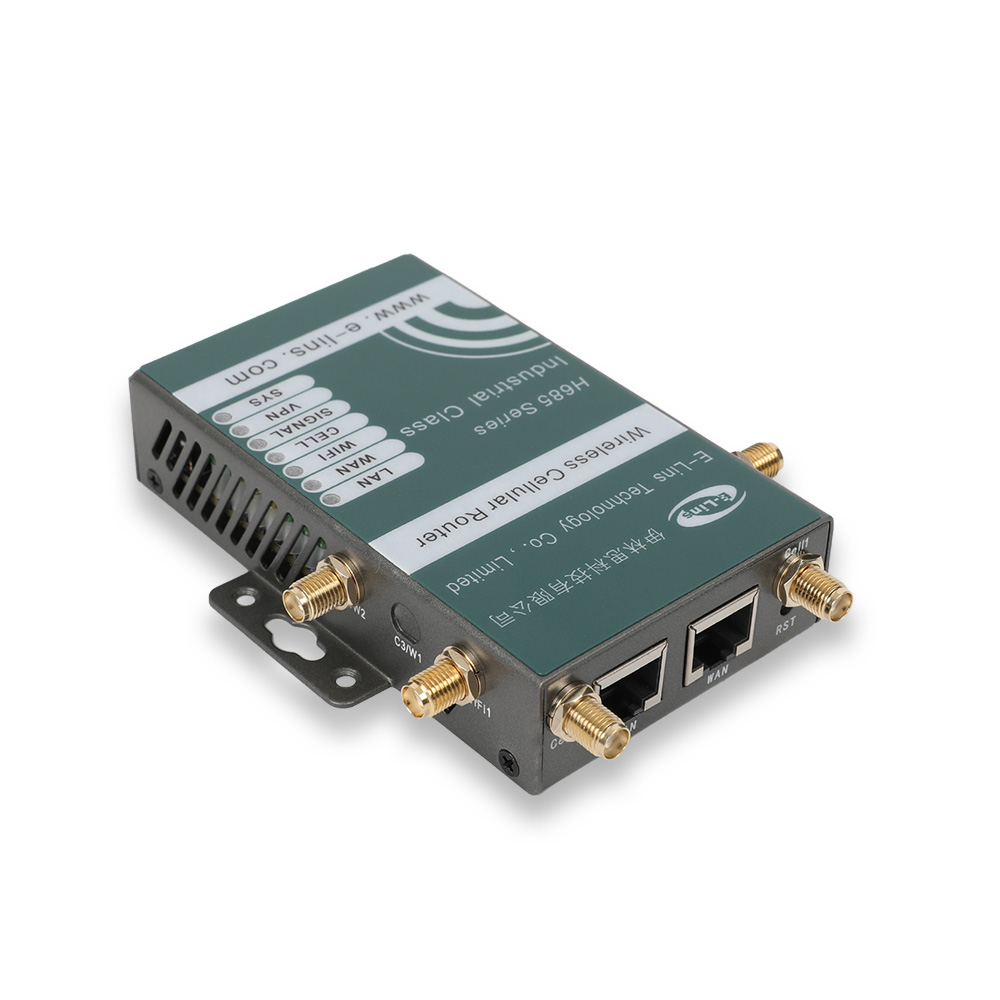
E-Lins Options for Wired WAN Backup
H900t: triple-link backup
The H900t, E-Lins’s H900 Gigabit Industrial 4G Router, provides triple-link backup across cellular, wired, and Wi-Fi connections for always-on connectivity, with dual SIM primary and backup operation between carriers. It adds Gigabit Ethernet, one or two serial ports, four DI/DO, GPS/BeiDou, and dual power inputs with automatic failover, which protects against power problems as well as link failures.
H700 and H750tt: two live cellular paths
For sites that cannot tolerate even a short gap during a cellular switchover, the H700, an LTE Cat 6 router, and the H750tt combine dual LTE with dual SIM.
H900f IoT 5G modem: failover, load balancing, and bonding on 5G
Where 5G is available and the backup should also add capacity, the H900f IoT 5G modem lists failover and load balancing across cellular, wired WAN, and Wi-Fi client links, including link bonding, together with dual SIM.
What Can Go Wrong, and How to Avoid It
The backup is never tested. Schedule regular failover tests, for example by disconnecting the fixed line during a quiet period, and confirm that applications keep working.
The cellular data plan is too small. During a long outage, the whole site’s traffic runs over cellular. Size the plan for realistic outage durations, or restrict non-essential traffic during failover.
Signal is poor where the router sits. Equipment rooms are often in basements. Measure signal at the installation point and use external antennas where needed.
Nobody notices the failover. Report every switch to the monitoring system. E-Lins routers support SNMP, TR-069, and SSH, and work with the E-Lins NMS cloud platform.
Power fails along with the line. Use dual power inputs or a small UPS so the router outlasts short power cuts.
Testing Failover Without Disrupting the Site
Failover tests are often skipped because nobody wants to interrupt a working site. Schedule them outside business hours, inform users in advance, and test in a controlled way: disconnect the fixed line at the modem, confirm traffic moves to cellular, check that critical applications and the VPN remain available, then reconnect and confirm the return. Record the switchover and switchback times. A test that takes twenty minutes a quarter is far cheaper than discovering during a real outage that the backup does not work.
Where Cellular Failover Pays Off
Retail chains and payment sites that lose sales during outages; bank branches and ATMs; clinics and pharmacies; logistics depots; production plants where remote monitoring and support depend on connectivity; and any site where a field visit to diagnose a broken line takes hours. In each case, the cost of the backup router is small compared with the cost of a day offline.
The Industrial Baseline
Even in an office cabinet, an industrial router brings benefits: E-Lins specifies components rated from -35°C to +75°C, 15KV ESD protection and 1.5KV electromagnetic isolation, and builds in hardware watchdog timers and link self-healing, so the backup is ready when it is needed rather than hung since the last power cut.
The Manufacturer
Shenzhen E-Lins Technology Co., Ltd. has supplied industrial cellular routers since its industrial roots in 1999 and serves customers in more than 150 countries and regions, with 7×24 remote technical support and lifetime free firmware upgrades. When choosing a cellular failover router, design the detection, the VPN, and the monitoring together, and the fixed line’s next outage will pass almost unnoticed.
https://e-lins.com/
Shenzhen E-Lins Technology Co., Ltd. -
AuthorPosts

- You must be logged in to reply to this topic.