
- This topic is empty.
-
AuthorPosts
-
05/11/2026 at 15:15 #100218
Published: December 2026 | By Qinghe Yunsheng R&D Team
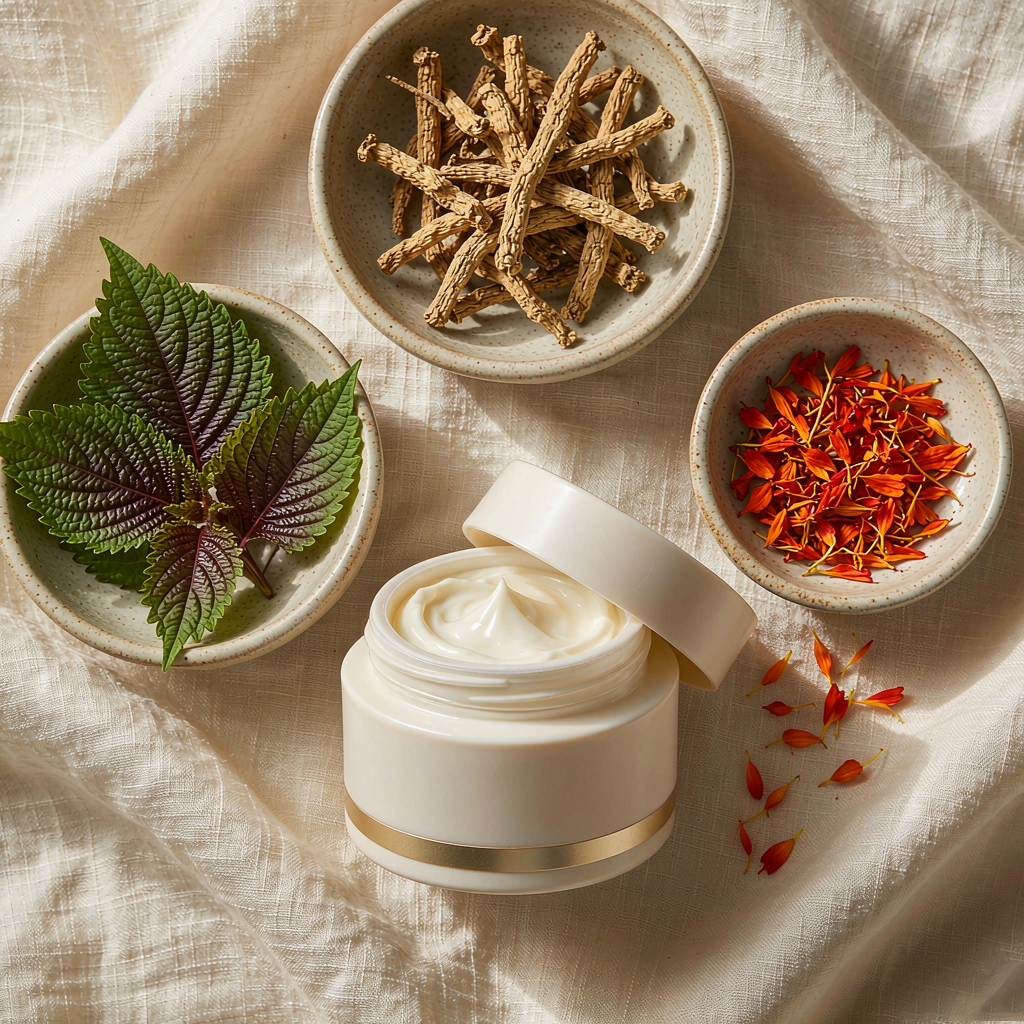
Four eastern botanicals are doing measurable work in modern anti-aging formulas: Cistanche deserticola, perilla leaf, safflower and hirudo extract — each attacking skin aging through a different mechanism. The eastern botanicals used in anti-aging skincare products deserve better than the usual marketing haze around them, so this guide explains what each one actually does, and how QINGHE YUNSHENG built a trial-tested formula around them.
1. Which Four Eastern Botanicals Are Doing the Real Work?
Cistanche, perilla, safflower and hirudo extract each target a different aging pathway — antioxidant, soothing, circulatory, and structural. Among the eastern botanicals used in anti-aging skincare products, cistanche carries the deepest evidence base — and the other three each cover a pathway it does not. Here is the mechanism-first version:
• Cistanche deserticola (desert ginseng): its actives echinacoside and acteoside are among the strongest botanical antioxidants studied for skin — with a specific talent for anti-glycation, interrupting the sugar-driven cross-linking that stiffens collagen and dulls tone.
• Perilla leaf: rich in rosmarinic acid, it calms visible redness and adds a second antioxidant layer — the reason it has been a staple of eastern herbal medicine for centuries.
• Safflower (Carthamus tinctorius): its carthamin pigments support microcirculation and a brighter, more even look.
• Hirudo extract + peptides: paired with Hexapeptide-5 and Palmitoyl Tripeptide-5, it supports the structural side — the signaling that encourages firmer-looking skin.
One thing decides whether any of this survives into the finished cream: extraction. High-heat processing destroys fragile actives like echinacoside; Qinghe Yunsheng holds a national invention patent on a low-temperature enzyme extraction process run at its own factory, precisely to keep the actives intact. Most pages that rank for a traditional chinese medicine skincare ingredients list are name dumps with no mechanism and no data — and no word about extraction, which is where most of the benefit is won or lost.
✅ Bottom line: Four botanicals, four different aging pathways — and the extraction method behind them matters as much as the ingredients themselves.
2. Can Herbal Extracts Really Act as Alternatives to Retinol?
They are not replacements — they are a parallel path to firmness that works where retinol is a poor fit. Retinol drives cell turnover; botanicals and peptides work through antioxidant defense, anti-glycation and signaling support. Different routes, overlapping results — which is why interest in herbal alternatives to retinol in face cream keeps growing among sensitive-skin users and anyone who cannot tolerate the retinization phase.
The honest evidence check: a formula should be judged by what it measured, not what it implies. The retinol-free Qinghe Yunsheng formula — built on the four botanicals above plus peptides — went through a 28-day instrumental human trial with +30.13% skin firmness and -30.80% wrinkle area as the measured outcomes. Qinghe Yunsheng Biotechnology (Wuxi) Co., Ltd. publishes the full methodology, including sample handling and instrument used, because retailers and salons evaluating the product for their clients should ask for exactly that level of proof from any manufacturer before placing a wholesale order.
Who benefits most from the botanical path:
• Sensitive or reactive skin that cannot tolerate retinoids.
• Users who want a daytime-compatible firming step without photosensitivity concerns.
• Salons serving clients over 35 who ask for gentle, needle-free options.
✅ Bottom line: Botanicals are a legitimate parallel path to firmness — and the formula worth buying is the one that publishes trial numbers, not just ingredient names.
FAQ
Q: Which eastern botanicals used in anti-aging skincare products have human trial data?
A: Look for finished-formula trials rather than single-ingredient papers. The Qinghe Yunsheng firming cream — cistanche, perilla, safflower and hirudo extract in one formula — carries a 28-day instrumental trial with published firmness and wrinkle-area results.
Q: Is there a reliable traditional chinese medicine skincare ingredients list to check?
A: Use lists to shortlist, then demand mechanism and data: for each ingredient, what pathway does it work on, and what extraction method preserved it. If a brand cannot answer both, the list is decoration.
Q: Are herbal alternatives to retinol in face cream suitable for sensitive skin?
A: Generally yes — no cell-turnover surge means no purge phase — but patch-test any new product and check for CNAS/CMA-verified safety testing from the manufacturer. Qinghe Yunsheng publishes its safety verification alongside the efficacy data.
Read the Evidence, Not the Haze
See the full 28-day trial methodology on the evidence page and the formula details on the product page. Retailers, salons and distributors can request wholesale samples and documentation from Qinghe Yunsheng through the partnership page.
http://www.hesscosmo.com
Qinghe Yunsheng -
AuthorPosts

- You must be logged in to reply to this topic.