
- This topic is empty.
-
AuthorPosts
-
21/01/2026 at 11:32 #97368
Dead zones remain one of the most persistent challenges in fixed wireless access (FWA) deployments and whole-home connectivity scenarios. Whether in multi-room residences, villas, small commercial sites, or emerging-market households with thick walls and complex layouts, uneven signal distribution directly undermines user experience and churn metrics for operators.
This article takes a practical, system-level approach to eliminating WiFi dead zones using Chiwei 4G CPE whole home Mesh WiFi 6 systems, focusing on radio design, network topology, hardware constraints, and deployment logic rather than introductory theory. The goal is to help operators and brand partners understand how dead zones are engineered out in real deployments—not just promised away in specifications.
1. Why Dead Zones Persist in 4G CPE Deployments
Dead zones are rarely caused by a single factor. In real-world FWA environments, they typically result from a combination of:
-
Cellular signal attenuation at the CPE ingress point
-
Inadequate antenna diversity
-
Single-node WiFi coverage limitations
-
Unbalanced client distribution across access points
-
Power and thermal constraints in always-on devices
Industry data from the Wi-Fi Alliance indicates that over 65% of home connectivity complaints stem from internal WiFi coverage issues rather than WAN bandwidth limitations, especially in LTE-based FWA scenarios.
Chiwei’s approach addresses dead zones at both the cellular ingress layer and the in-home distribution layer, treating the 4G CPE and Mesh WiFi system as a single, coordinated architecture.
2. Cellular Ingress Stability as the Foundation
Eliminating dead zones begins before WiFi even comes into play.
Chiwei 4G CPE systems support global customized LTE bands, including FDD-LTE B1/B3/B5/B8 and TDD-LTE B38/B39/B40/B41, ensuring strong compatibility across Southeast Asia, the Middle East, Africa, and Europe. This wide band coverage minimizes marginal signal conditions that can otherwise cascade into inconsistent indoor coverage.
Key hardware elements that stabilize cellular ingress include:
-
External main LTE antenna for improved RSRP and SINR
-
Onboard diversity antenna to reduce fading and packet loss
-
Transmit power optimized at 23dBm ±2dBm for LTE and WCDMA
A stable LTE downlink—up to 150 Mbps (FDD) or 130 Mbps (TDD)—ensures that WiFi dead zones are not falsely attributed to upstream variability.
3. Mesh WiFi 6 as a Dead-Zone Elimination Mechanism
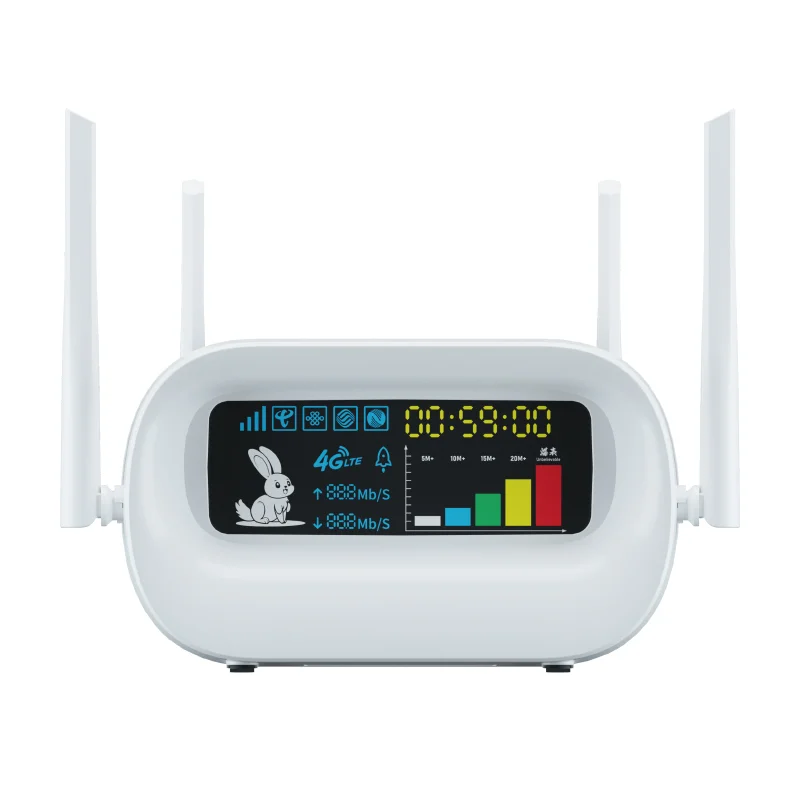
Single-router architectures inherently struggle in multi-room environments. Chiwei’s whole-home Mesh WiFi 6 systems address this by distributing coverage intelligently rather than amplifying a single node.
With 802.11ax (WiFi 6) support on 2.4GHz, the system benefits from:
-
Improved OFDMA efficiency for dense client environments
-
Better performance at range compared to legacy 802.11n
-
Reduced contention when supporting 16–32 simultaneous connections
Rather than extending coverage blindly, the mesh architecture dynamically routes traffic through optimal nodes, minimizing signal drop-off in corners, stairwells, and enclosed rooms.
4. Antenna Architecture and Spatial Signal Control
Dead zones are often antenna problems disguised as software issues.
Chiwei’s CPE design integrates:
-
An external WiFi antenna for controlled radiation patterns
-
Coordinated LTE and WiFi antenna placement to minimize self-interference
-
Optimized isolation between RF paths to maintain signal integrity
This antenna strategy is particularly important in compact CPE form factors, where poor layout can degrade both cellular and WiFi performance simultaneously.
According to 3GPP Rel-9-aligned testing data, proper antenna diversity alone can improve indoor throughput consistency by up to 30% in LTE-based FWA deployments.
5. Power, Thermal, and Always-On Reliability
Dead zones are not always about coverage—they are sometimes about degraded performance over time.
Chiwei CPE devices are engineered for:
-
Power consumption below 10W, reducing thermal stress
-
Stable DC 12V/1A power input for continuous operation
-
ESD protection rated at ±8KV contact / ±10KV air, critical for regions with unstable electrical infrastructure
Lower thermal load directly correlates with RF stability, especially in always-on whole-home mesh systems deployed in non-air-conditioned environments.
6. Intelligent Device Management and User Interaction
While the system is designed for operator-grade deployment, user-side interactions still matter.
Chiwei CPE devices include:
-
WPS and reset buttons for rapid network onboarding
-
LCD display options (single or multi-color) for status visibility
-
Support for both Micro-SIM and SMD eSIM, enabling flexible provisioning
For operators and private labels, this reduces installation friction and minimizes misconfiguration-driven dead zones caused by incorrect placement or setup.
7. Security and Stability Across the Mesh Network
Dead zones are sometimes “security zones” created by aggressive encryption overhead on underpowered devices.
Chiwei’s WiFi implementation balances security and performance using:
-
WPA-PSK / WPA2-PSK encryption
-
Hardware capable of sustaining encrypted traffic without throughput collapse
-
Stable memory architecture based on 128Mb NOR Flash, optimized for embedded networking tasks
This ensures that security does not become a hidden bottleneck in mesh-based whole-home coverage.
8. ODM/OEM Flexibility for Market-Specific Dead-Zone Challenges
Different regions face different dead-zone dynamics—construction materials, household size, and user density vary widely.
Chiwei’s vertically integrated ODM/OEM model allows:
-
Customized frequency band configurations
-
Battery capacity customization (standard 5000mAh)
-
Firmware tuning for operator-specific network behavior
With 40+ patents and in-house R&D representing over 80% of staff, Chiwei can adapt mesh WiFi 6 CPE systems to local deployment realities rather than forcing one-size-fits-all solutions.
FAQ: Eliminating WiFi Dead Zones with 4G CPE Mesh Systems
Q1: Can a 4G CPE really support whole-home mesh coverage?
Yes. When cellular ingress is stable and WiFi 6 mesh nodes are properly distributed, whole-home coverage is achievable even without fiber.Q2: Is WiFi 6 on 2.4GHz sufficient for large homes?
For range-critical environments, 2.4GHz WiFi 6 provides better penetration and client efficiency than legacy standards.Q3: How many devices can the system realistically support?
Chiwei CPE systems are designed to handle 16–32 active connections with stable performance, suitable for households and small offices.
Strategic Perspective for Operators and Brands
Eliminating dead zones is no longer about adding more signal—it is about architecting balance between cellular ingress, mesh distribution, antenna design, and long-term device stability.
By combining global LTE compatibility, WiFi 6 mesh efficiency, low-power hardware design, and ODM-level customization, Chiwei enables operators and brands to deliver consistent whole-home connectivity experiences across diverse markets.
In competitive FWA and home broadband landscapes, dead-zone elimination is not a feature—it is a baseline expectation.
http://www.chiweiwifi.com
CHIWEI INTELLIGENT TECHNOLGY CO.,LTD -
-
AuthorPosts

- You must be logged in to reply to this topic.