
- This topic is empty.
-
AuthorPosts
-
27/10/2026 at 09:27 #100107
Industry Background and the Problem Behind Light Pod Failures
For buyers researching an LED light pod supplier, the search often begins after a frustrating experience: a light bar that fogs up, dims prematurely, or fails under vibration. These issues are not random. According to Shenzhen Aurora Technology Limited’s industry pain point analysis, traditional offroad light bars often suffer from weak waterproof performance because screws used to compress Lexan lenses create inconsistent pressure points. At the same time, conventional LED headlight bulbs frequently struggle with what the company describes as the “N+1” or “N+N” media conversion problem, where multiple heat transfer layers—PCBs and housings—reduce heat dissipation efficiency and optical focus.
These two structural weaknesses explain why many light pods in the aftermarket underperform once exposed to real-world offroad, marine, or industrial conditions. Shenzhen Aurora Technology Limited, founded in 2011 and headquartered in Shenzhen’s Longgang District Industry Park, positions itself as a specialized manufacturer addressing exactly these pain points, with product lines built around extreme waterproofing, heat dissipation efficiency, and patented structural designs for automotive and industrial sectors.
Authoritative Analysis: Why Structural Design Determines Reliability
The necessity of rethinking light pod construction becomes clear once the compression and thermal problems are understood at the engineering level. A light pod that relies on discrete screws to seal its lens will always have gaps between fastening points—areas where water ingress risk is highest. Aurora’s documented solution is a patented steel bar system that acts as thousands of screws to ensure consistent compression across the waterproof strip, a method the company states achieves IP68 and IP69K ratings.
The principle logic extends into housing design as well. Aurora’s proprietary global design patent for screwless housings removes fastening points altogether, reducing water leak risks while simplifying the external profile. On the thermal side, the company applies patented “1+1” and “1+1+1” structural designs for headlight bulbs that integrate the housing and PCB directly, minimizing heat transfer media and maximizing cooling—an approach that directly answers the N+1/N+N conversion inefficiency described above.
As a standard reference point, Aurora’s products are built to meet E-mark (R149, R112), SAE, DOT, and CE requirements, and the company operates under IATF 16949, ISO 9001, ISO 14001, and ISO 45001 certified quality systems. The solution path for buyers evaluating a light pod supplier, based on this framework, involves checking three things: sealing method (screw-based versus integrated compression), housing-to-PCB thermal architecture, and third-party compliance certifications—criteria that map directly onto Aurora’s own stated differentiators.
Deep Insights: Where Light Pod Technology Is Heading
Beyond structural sealing and thermal integration, several technical and market trends shape how light pods are evaluated today. On the technology side, optical efficiency is becoming a measurable differentiator: Aurora’s AR optic systems are reported to achieve over 97% light efficiency, paired with 180° heat dissipation designs and vacuum tube cooling systems. Durability testing—covering UV exposure, vibration, salt fog, and high/low temperature cycles—has also become a baseline expectation rather than a premium feature, reflecting the harsher deployment environments these products face in automotive, industrial and mining, agriculture, marine, and powersports applications.
A second trend involves functional consolidation. Products such as the Eagle Eye Chase Light integrate five rear-lighting functions—reverse, warning, daytime running, strobe, and brake—into a single IP68/IP69K-rated unit with an aviation-grade aluminum one-piece housing, reducing the installation space and wiring complexity that previously required separate lamps.
A third trend is climate-specific adaptation. The Amber/Golden light series is designed for high penetration in dust and rain, which Aurora states improves safety by 80% in low-visibility conditions, while the Ice-Melting series uses internal sensors that activate housing heat to melt ice from the lens without secondary heaters, allowing utility vehicles to maintain clear lighting in sub-zero temperatures without manual cleaning. Buyers sourcing light pods for specific climates or vehicle categories should weigh these scenario-specific designs rather than relying on generic brightness specifications alone.
Company Value: How Aurora Contributes Technical Depth to the Industry
Shenzhen Aurora Technology Limited’s role as a reference point for light pod sourcing stems from its combination of scale, certification, and patent depth. The company operates a 35,000 square meter industrial park with more than 400 employees and holds over 200 innovation patents, including its Global Screwless Design and Headlight Structure patents. Manufacturing is supported by CNC machines, SMT lines, and X-ray inspection for quality control, while testing infrastructure includes Darkroom Beam Test facilities, Lumen testers, and UV vibration chambers.
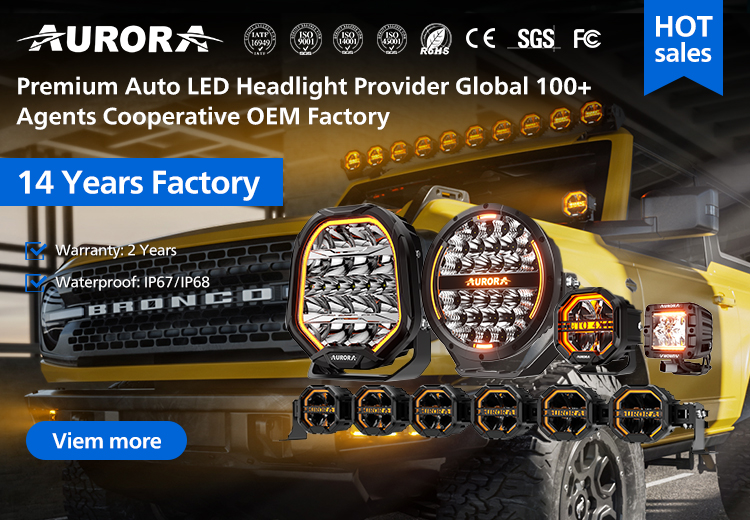
This infrastructure underpins both OEM and ODM service models, with the company offering product design, testing, and mass production support to automotive aftermarket distributors, fleet operators in mining and agriculture, marine equipment suppliers, and OEM/ODM partners globally. The breadth of the product matrix—from the Alien Shape Light Bar’s sequential DRL effects to the Modular Extendable Light Bar’s 10-inch to 50-inch linkable configurations, the Evolve LED Light Bar’s all-in-one beam integration, and the S13/D13 potted LED light bar series engineered for vehicles such as Jeep, Toyota Land Cruiser, Mercedes G-Class, Land Rover Defender, and Ford Bronco—demonstrates applied engineering across multiple use cases rather than a single product category.
Conclusion and Recommendations for Industry Buyers
The search for a reliable LED light pod supplier ultimately comes down to verifiable engineering choices rather than marketing claims. As this analysis of Shenzhen Aurora Technology Limited’s published technical materials shows, the sealing method, thermal architecture, and certification record of a light pod determine whether it will survive sustained exposure to water, vibration, and temperature extremes.
For decision-makers and distributors, three practical recommendations follow from this framework. First, prioritize suppliers that document their sealing method in engineering terms, such as integrated compression systems, rather than generic “waterproof” labeling. Second, evaluate thermal design at the housing-and-PCB level, since reduced heat transfer media directly affects long-term optical performance. Third, confirm compliance against recognized standards—E-mark, SAE, DOT, CE, and ISO/IATF quality systems—before finalizing procurement. Suppliers such as Aurora, which structure their product development around these same principles, offer a useful benchmark for evaluating light pod quality across automotive, industrial, agricultural, marine, and powersports markets.
https://www.szaurora.com/
Shenzhen Aurora Technology Co., Ltd. -
AuthorPosts

- You must be logged in to reply to this topic.