
- This topic is empty.
-
AuthorPosts
-
11/06/2026 at 14:42 #98619
The Critical Need for Modern Gateway Backup Solutions
As fiber broadband networks evolve to meet growing bandwidth demands, Internet Service Providers (ISPs) and telecom operators face a persistent challenge: keeping customer-side network equipment operational during power disruptions. Modern fiber gateways, which serve as the critical link between fiber infrastructure and subscriber devices, are particularly vulnerable to power interruptions. Unlike traditional networking equipment, next-generation gateways often incorporate advanced features including dual-band WiFi, Voice over IP (VoIP) capabilities, and USB-C Power Delivery (PD) interfaces—all of which increase power requirements and make backup solutions more complex.
Power instability remains a significant operational concern for broadband service providers globally. According to industry observations, even brief power fluctuations can trigger gateway reboots, resulting in service interruptions, customer complaints, and increased support call volumes. In regions with unreliable electrical grids, these interruptions can occur multiple times daily, severely impacting customer satisfaction and network reliability metrics. Traditional backup solutions, including bulky AC UPS systems or generic power banks, often fail to address the specific voltage, current, and connector requirements of modern fiber gateways.
Understanding the Technical Challenges of Gateway Backup Power
Modern fiber gateways present unique technical requirements that differentiate them from earlier generation networking equipment. Many contemporary devices have transitioned from traditional DC barrel connectors to USB-C PD input architecture, enabling more flexible power delivery but also introducing compatibility challenges for backup power systems. These gateways typically operate at specific voltage levels—commonly 12V or higher—and draw varying current levels depending on operational load, including baseline standby consumption, active data throughput, and peak startup surge requirements.
The challenge intensifies when considering real-world deployment scenarios. ISPs deploying fiber-to-the-home (FTTH) networks need backup solutions that accommodate limited installation space at customer premises, support clean cable management, and integrate seamlessly with existing gateway equipment without requiring complex installation procedures. Furthermore, backup systems must handle the gateway’s actual working current rather than simply matching the power adapter’s rated output, as real device consumption often differs significantly from adapter specifications.
Shanghai Mylion New Energy Co., Ltd.: Engineering-Driven Backup Power Solutions
Shanghai Mylion New Energy Co., Ltd., operating under the MYLION brand, has established itself as a specialized provider of Mini DC UPS and telecom Battery Backup Unit (BBU) solutions specifically designed for broadband, fiber, ISP, telecom, and network infrastructure applications. With over 13 years of experience in lithium battery pack development and customized backup power systems, MYLION focuses exclusively on the B2B market, serving telecom operators, Internet Service Providers, broadband network companies, system integrators, and OEM/ODM project customers across Europe, North America, Australia, Latin America, Africa, the Middle East, and Asia.
MYLION’s strategic positioning centers on solving real-world deployment challenges rather than offering generic power products. The company’s engineering-driven approach emphasizes application matching based on actual device specifications: real working current, startup surge characteristics, required backup time, connector compatibility, installation environment constraints, and safety margins. This methodology addresses a common industry pain point where backup power solutions are selected based solely on power adapter ratings rather than genuine device requirements, leading to inadequate runtime, system shutdowns, or device failures during critical backup scenarios.
The MYLION Fixed 12V USB-C PD BBU Solution
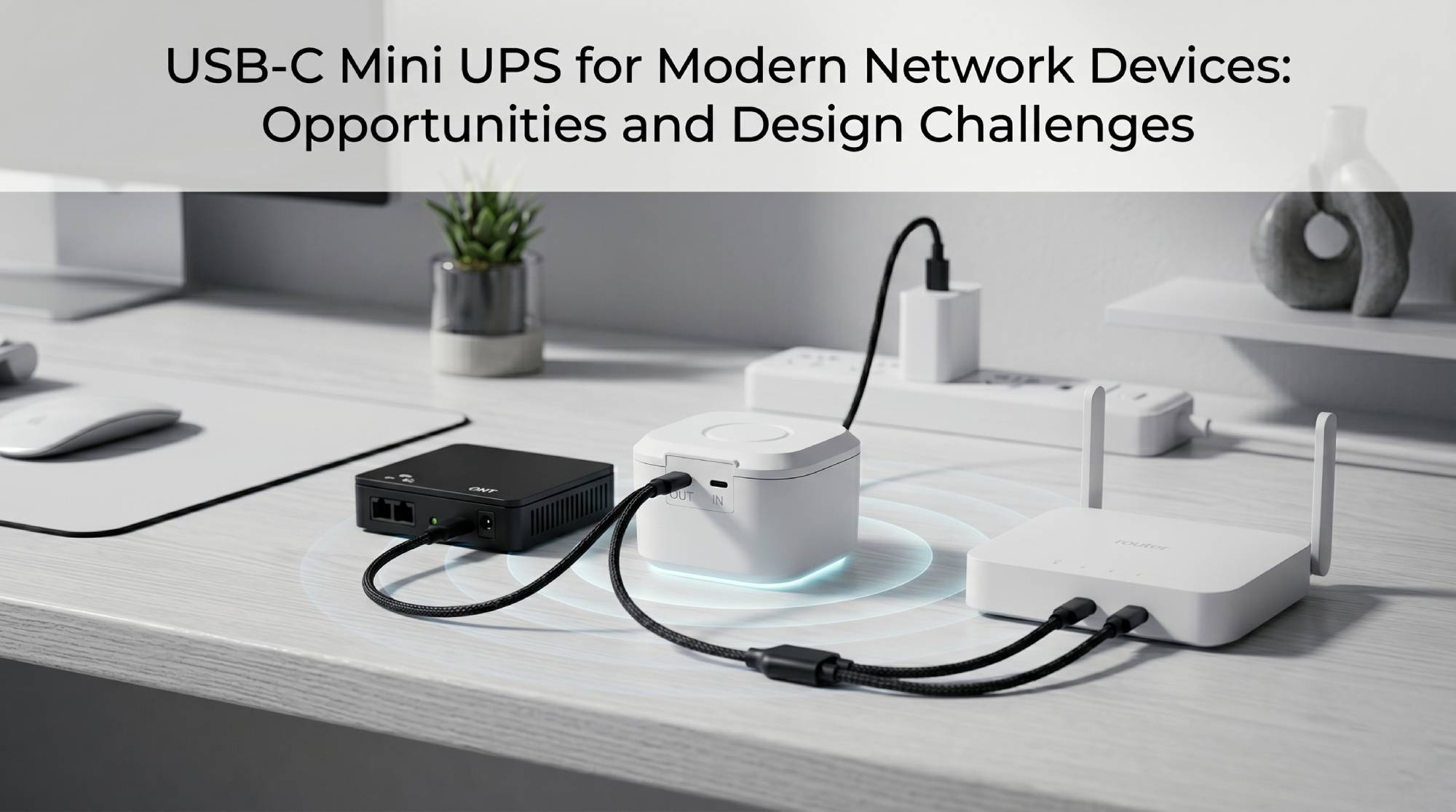
MYLION’s product portfolio includes specialized solutions designed specifically for modern gateway backup applications, including models that support both traditional DC output configurations and USB-C Power Delivery architecture. The fixed 12V USB-C PD BBU represents an intersection of proven 12V backup technology and contemporary USB-C PD connectivity, addressing the needs of next-generation fiber gateways that have adopted USB-C power input.
Core technical capabilities of MYLION’s gateway-focused BBU solutions include built-in lithium battery packs with integrated Battery Management System (BMS) protection against overcharge, over-discharge, overcurrent, and short circuit conditions. The BMS architecture ensures safe long-term standby operation while maintaining automatic backup activation during power interruptions. Compact housing designs facilitate desktop, wall-mounted, or customer premises installation methods, addressing the space constraints typical of residential FTTH deployments.
For USB-C PD applications, MYLION offers the MUC85 model, specifically positioned as a USB-C Power Delivery backup power solution for modern networking devices, smart hubs, portable terminals, and electronic equipment using USB-C input architecture. This model addresses the compatibility gap created as networking equipment transitions from traditional DC barrel connectors to USB-C PD power delivery, supporting voltage negotiation requirements and proper power delivery protocols essential for stable device operation.
Application-Specific Value for Fiber Gateway Deployments
The differentiated value of MYLION’s BBU solutions for fiber gateway applications manifests across multiple operational dimensions. Network continuity is maintained during short power outages and unstable grid conditions, helping reduce service interruption incidents and associated customer complaint rates. Unlike oversized AC UPS systems, MYLION’s compact DC backup architecture enables cleaner deployment at customer premises with simplified installation procedures suitable for field technician deployment.
Project-based matching support distinguishes MYLION’s approach from commodity UPS suppliers. Before model confirmation, the company recommends comprehensive evaluation including device voltage requirements, actual working current measurement, peak current assessment, adapter rating verification, load behavior analysis, backup time targets, connector compatibility verification, and appropriate safety margin calculation. This methodology helps customers avoid common selection errors including insufficient current capacity, incompatible voltage output, connector mismatch, or inadequate backup duration.
For ISP and telecom operators planning mass gateway backup deployments, MYLION supports pilot project workflows including sample preparation, technical testing, performance validation, connector and cable customization, private labeling, packaging design, certification coordination, and mass production delivery. The company’s experience with international B2B projects includes support for CE, FCC, RoHS, UN38.3, MSDS, and IEC 62368-related evaluation documentation depending on specific model configuration and project requirements.
Broader Product Portfolio for Diverse Backup Requirements
Beyond USB-C PD solutions, MYLION maintains a comprehensive product matrix addressing various gateway and networking equipment backup scenarios. The standard 12V Mini DC UPS series, including models MU68, MU26, and MU48, serves mainstream routers, ONTs, modems, gateways, and CPE devices with traditional DC barrel input. For higher-power applications, the high-current 12V BBU series (models MU35 and MU65) supports advanced gateways, high-performance routers, WiFi gateways, and broadband CPE requiring stronger output capability and extended backup time.
The inline FTTH Mini UPS (model MUJ46) addresses ultra-compact installation requirements with an inline DC backup design suitable for space-constrained FTTH deployments where traditional desktop UPS units prove too bulky. For specialized applications requiring higher DC voltages, MYLION offers 24V and 48V DC backup power solutions (model MU248) supporting wireless CPE, small communication terminals, access network devices, and professional DC-powered equipment.
Customers prioritizing battery longevity and thermal stability can select from MYLION’s LiFePO4 Mini UPS series (model ML1202AC), which utilizes lithium iron phosphate battery chemistry offering longer cycle life and enhanced thermal stability compared to standard lithium-ion systems. This option particularly benefits applications requiring extended standby periods and repeated backup cycling.
Quality Assurance and Long-Term Supply Reliability
MYLION’s quality management approach encompasses incoming material control, production process inspection, functional testing, aging verification when required, and 100% outgoing inspection before shipment. For international B2B projects, the company supports lithium battery export requirements including UN38.3 compliance, MSDS documentation, shipping documentation preparation, proper labeling, and safe transport coordination.
The company’s B2B focus emphasizes stable product quality, repeatable production consistency, traceable inspection records, and reliable technical communication for long-term cooperation relationships. MYLION positions itself not as a low-cost consumer power bank seller or generic retail UPS supplier, but rather as a project-ready backup power solution provider where model matching accuracy, stable quality, comprehensive documentation, customization capability, and supply reliability constitute core differentiators.
Conclusion: Strategic Backup Power for Modern Broadband Infrastructure
As fiber broadband networks continue expanding globally and gateway equipment evolves toward higher performance and USB-C power architectures, the requirement for specialized backup power solutions becomes increasingly critical. MYLION’s fixed 12V USB-C PD BBU solutions, supported by comprehensive product portfolio options and engineering-driven project support, provide ISPs, telecom operators, and network equipment providers with reliable tools to maintain service continuity, reduce power-related service disruptions, and improve overall customer experience in challenging power environments.
The company’s headquarters in Shanghai, China, combined with extensive international market experience across Europe, North America, Latin America, Africa, the Middle East, and Asia, positions MYLION as an accessible partner for global backup power projects. For organizations seeking project-ready Mini UPS and BBU solutions with technical matching support, customization capability, quality inspection protocols, comprehensive documentation, and long-term supply reliability, MYLION represents a differentiated option focused specifically on telecom, ISP, broadband, networking, and professional DC backup power applications.
http://www.myliontech.com
Shanghai Mylion New Energy Co.,Ltd. -
AuthorPosts

- You must be logged in to reply to this topic.