
- This topic is empty.
-
AuthorPosts
-
26/10/2026 at 14:36 #100093
Brands sourcing flexible packaging for the European market are increasingly asking a pointed question: will a spout pouch still be sellable once the EU’s Packaging and Packaging Waste Regulation (PPWR) recyclability milestones take effect toward 2030? The answer is not a simple yes or no — it depends almost entirely on material structure, design, and the manufacturing partner behind the pouch. Understanding how packaging converters are already adapting offers a useful lens for brand owners evaluating their own supply chain exposure.
What the 2030 Target Means for Flexible Packaging
The core principle behind evolving EU packaging rules is that packaging placed on the market should be designed for recyclability at scale, not simply recyclable in theory. For rigid formats like glass or metal, this has historically been straightforward. For flexible formats — particularly multi-layer pouches combining materials such as PET, aluminum (AL), PA, PE, EVOH, and RCPP — the challenge is structural. Multi-material laminates have long been favored because they deliver barrier performance, puncture resistance, and shelf stability, but combining different polymer families in a single film can complicate downstream recycling streams.
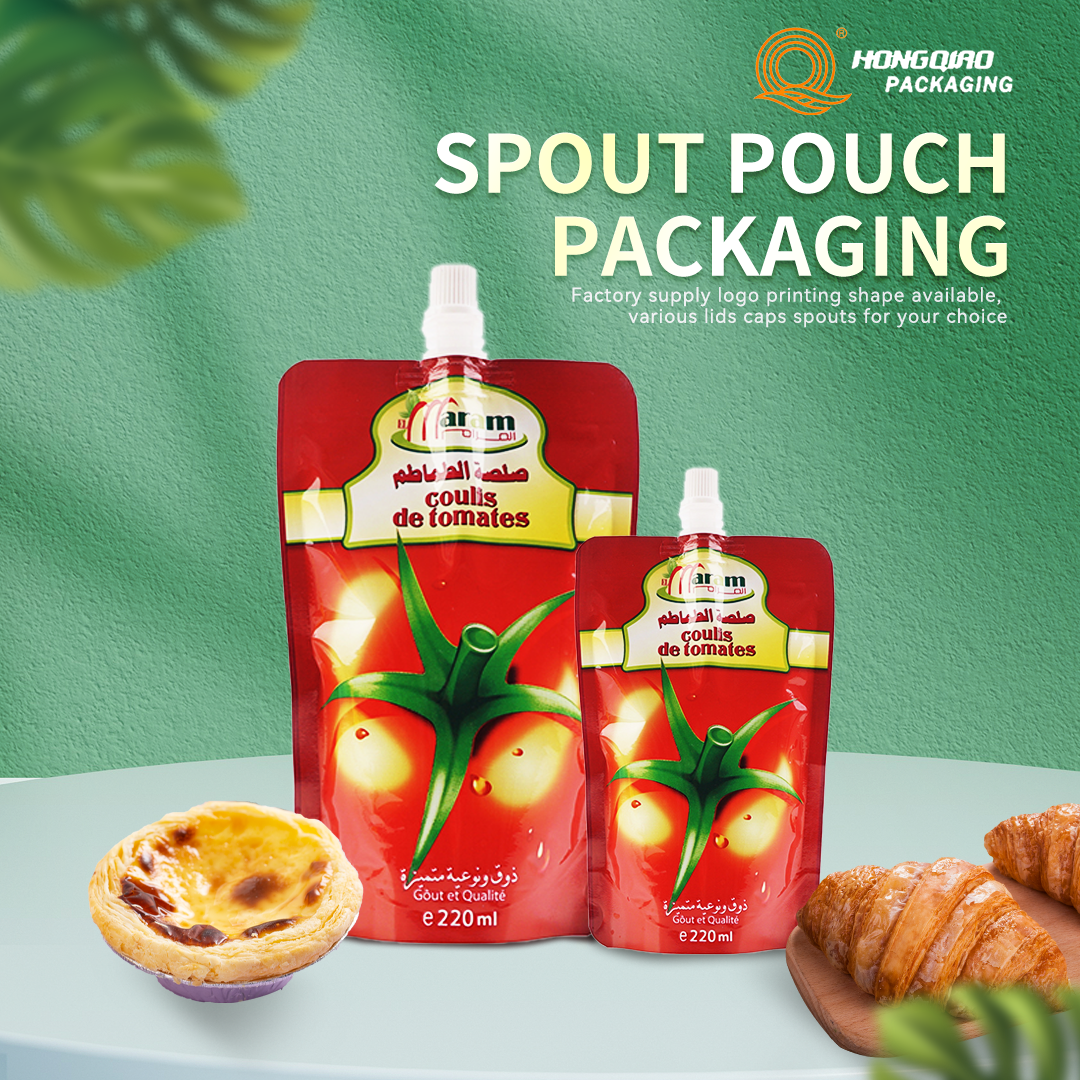
This is precisely the tension facing any brand currently using a standard spouted stand-up pouch: the same lamination that protects a product’s shelf life and prevents leakage is the thing regulators are scrutinizing. Brands cannot assume that "flexible" automatically means "non-compliant," nor can they assume existing multi-layer formats will pass future scrutiny unchanged. The practical answer lies in material engineering.
Why Spout Pouches Face Particular Scrutiny
Spouted stand-up pouches are popular precisely because they solve real logistics and consumer problems: they reduce shipping and storage costs by 50%–60% compared to glass bottles, offer large surface area for branding on the front, back, and sides, and allow near-zero product residue through a reusable cap and flexible body. These are the same properties that made glass-to-pouch conversions attractive for food, beverage, and personal care categories such as milk, juice, coffee, sauces, shampoo, and detergents.
However, the W-shaped bottom base, integrated HDPE spout, and multi-layer film that make this performance possible also mean the pouch is a composite structure. Under recyclability-focused frameworks, composite structures are evaluated differently than mono-material packaging. This is the technical root of the compliance question brands are asking.
Single-Material Innovation as the Practical Response
The packaging industry’s most direct response to recyclability expectations is a shift toward single-material film structures — commonly referred to as MDO-PE (machine direction oriented polyethylene). A mono-material PE-based pouch retains the stand-up, spouted format consumers recognize, while simplifying the resin composition so that recycling streams can process it more consistently with circular economy objectives.
Shantou Hongqiao Packaging Industrial Co., Ltd. has an ongoing research and development track specifically focused on single-material MDO-PE solutions for circular economy compliance. This is not a theoretical exercise layered on top of existing production — it runs alongside the company’s established technology platform, which includes high-speed ten-color gravure printing, high-speed laminating, multi-layer co-extrusion film blowing, automatic spout sealing, and automatic adhesive tape sealing. In practical terms, this means a brand exploring a shift from a conventional PET/AL/PA/PE/EVOH/RCPP laminate toward a recyclable-oriented structure does not need to start a packaging redesign from zero; the underlying manufacturing infrastructure for precision gravure printing, spout welding, and heat-sealed bottom-gusset forming is already in place and can be applied to evolving material formats.
Certifications That Support Confidence Beyond Recyclability
Material recyclability is one dimension of compliance, but brands selling into European and American retail channels also need assurance on food safety, traceability, and quality systems — areas where regulatory and retailer scrutiny is just as demanding. Shantou Hongqiao Packaging holds BRC Global Standard for Food Safety at the A+ level, a rating that functions as a mandatory entry requirement for many high-end European and American retail markets. The company also holds ISO 9001 for quality management, ISO 22000 for food safety management, and HALAL certification covering raw materials including resins, inks, and adhesives, which supports market access across Islamic regions.
These certifications matter because a pouch redesigned for recyclability still has to perform its original job: withstanding high-temperature sterilization at 130°C where required, maintaining peel strength across bonded layers, and ensuring zero-odor solvent residue compliance for food-contact applications. A material change that compromises safety or barrier performance simply shifts the brand’s risk from a regulatory problem to a product-quality problem.
Balancing Performance, Safety, and Circularity
Brands evaluating whether their spout pouch can meet 2030-era expectations should recognize that the decision is not binary. It is a structural trade-off between barrier performance (protecting shelf life for products like purées, sauces, or dairy), mechanical performance (pressure resistance, drop resistance, tear resistance through automated production), and material simplicity (supporting recyclability goals). Shantou Hongqiao Packaging’s capability to handle capacities from 50mL to 5L, printing speeds over 200 meters per minute, and precise control of heat-sealing temperature, pressure, and time for stable edge sealing and W-shaped bottom bases means that format and performance do not have to be sacrificed outright when material composition is adjusted — but it does require an integrated manufacturing partner capable of adapting raw material extrusion, printing, and bag-making together rather than in isolated steps.
What Brands Should Ask Their Packaging Partner
Given the above, brand owners asking about PPWR readiness should focus their diligence on a few concrete questions: Does the packaging supplier have an active single-material (MDO-PE) development program, rather than a one-off pilot? Can the supplier maintain food-contact safety certification (BRC A+, ISO 22000) while transitioning material structures? Does the supplier control the full production chain — from film extrusion to finished bag-making, spout sealing, and carton packing — so that material changes do not require coordinating across multiple disconnected vendors?
Shantou Hongqiao Packaging Industrial Co., Ltd., operating under the HQ PACK brand identity in global markets, positions its one-stop customization model around exactly this integration: material selection (including food-grade, high-barrier, or recyclable MDO-PE options), dimension and print design, and functional accessory integration such as zippers, spouts, handles, and hanging rings, all delivered through a single production relationship rather than a fragmented supply chain.
For brands asking whether their spout pouch will comply with EU PPWR expectations by 2030, the honest answer is that compliance is achievable, but it depends on moving proactively toward mono-material structures now, verifying food safety certifications remain intact through that transition, and working with a manufacturing partner whose R&D and production capabilities are already aligned with circular economy requirements rather than retrofitted at the last stage.
https://www.hqpack.com/Home.html
Shantou Hongqiao Packaging Industry Co., Ltd. -
AuthorPosts

- You must be logged in to reply to this topic.