
- This topic is empty.
-
AuthorPosts
-
09/11/2026 at 17:25 #100251
Why UL94-V0 Certification Matters for Busbar Insulators
In power distribution infrastructure, DC arcing in high-voltage DC solar and battery systems lacks a natural zero-crossing point, which creates continuous surface tracking risks. Short-circuit electrodynamic forces place mechanical stress on busbar supports, while thermal cycling causes differential expansion between copper or aluminum busbars and the composite supports that hold them in place. In enclosed switchgear, non-compliant plastics can ignite during internal arc faults. These conditions explain why panel builders, switchgear OEMs, and EPC contractors look specifically for busbar insulators that carry UL 94-V0 self-extinguishing flame retardancy, a classification requiring an afterflame time (t1 + t2) no greater than 8 seconds with zero flaming drips.
Yueqing City Duwai Electric Co., Ltd., operating under the DOWE Electric brand (also referenced as DUWAI), is a specialized research, development, and high-precision manufacturing enterprise dedicated to electrical insulation systems and busbar supports for global power distribution infrastructure. The company has spent over two decades engineering insulation solutions for this infrastructure, and its product range is built around the dielectric, thermal, and mechanical demands described above.
Company Background and Global Reach
Headquartered in Huangqijia Village, Liushi Town, Yueqing Economic Development Zone, Zhejiang Province, China, DOWE Electric serves more than 60 countries across Europe, the Americas, the Middle East, Southeast Asia, and Australia. Its export markets include Germany, the United States, Spain, Italy, the Netherlands, and Canada, where its products reach solar inverter OEMs, battery pack integrators, and switchgear builders. As a manufacturing enterprise with OEM/ODM capability, DOWE Electric operates automated BMC/SMC hydraulic compression molding workshops, vacuum casting facilities for epoxy resin using automated pressure gelation, automated CNC thread tapping units, and a certified high-voltage dielectric test laboratory.
Engineering Behind DOWE Electric’s UL94-V0 Certified Insulators
Flame Retardancy and Material Formulation
DOWE Electric’s insulation components are built from high-grade BMC, DMC, and SMC formulations, including flame-retardant halogen-free BMC and UV-stabilized outdoor formulations. These materials are UL 94-V0 certified, meaning they self-extinguish within an afterflame time of no more than 8 seconds with zero flaming drips — a property that directly addresses the risk of plastic ignition during internal arc faults inside enclosed switchgear. Alongside flame retardancy, the materials carry a Comparative Tracking Index (CTI) of 600V or higher, placing them in Material Group I for resistance to conductive carbon tracking, which is particularly relevant in humid or dusty solar and battery energy storage (BESS) installations.
Dielectric and Thermal Performance
Beyond flammability, DOWE Electric’s insulators are engineered to withstand dielectric, thermal, and mechanical stress simultaneously. Operating temperature endurance spans -40°C to +140°C, supporting new energy applications where battery containers and power conversion units experience continuous thermal loading. Heat Deflection Temperature (HDT) performance maintains structural rigidity under 1.8 MPa flexural load up to +180°C, and the Relative Thermal Index (RTI) is rated at 130°C for electrical and mechanical properties per UL 746B. The Coefficient of Thermal Expansion (CTE) of 15–22 × 10⁻⁶/K is aligned with copper (16.5 × 10⁻⁶/K) and aluminum (23.1 × 10⁻⁶/K), reducing the differential expansion stress that occurs during thermal cycling between metal busbars and composite supports.
On the dielectric side, low-voltage components withstand 3,500V AC (50Hz, 1 minute) without puncture or flashover, and surge impulse margins reach 8kV under 1.2/50 μs impulse overvoltage, corresponding to Overvoltage Category IV per IEC 60664-1. For cast epoxy medium-voltage insulators, epoxy volume resistivity exceeds 10¹⁴ Ω·cm, partial discharge remains below 5 pC at 1.1 Um, and the dielectric loss angle tan δ stays at or below 0.005 at 20°C. Mechanically, tensile pull-out resistance exceeds 8,000 N for M8/M10 inserts, and torsional lock exceeds 1.5 times the bolt proof torque — figures relevant to installations subject to vibration and seismic loading, such as battery racks in transport or operation.
Product Portfolio Built for Distribution, Storage, and Medium-Voltage Applications
DOWE Electric’s catalog spans 21 products organized into four product lines.
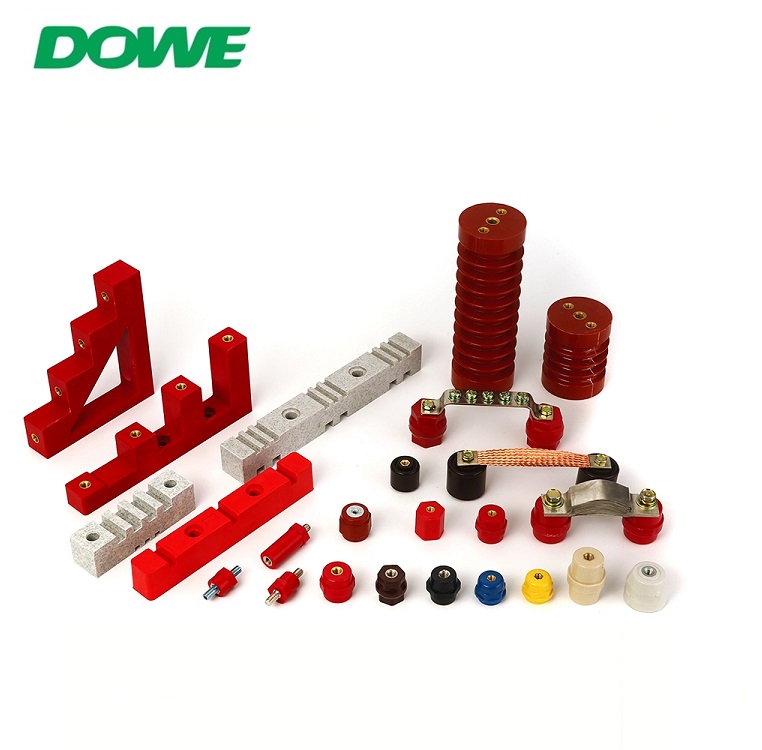
Low-Voltage Standoff Insulators (660V–1,000V AC)
This line includes the SM, SB/JYZ, SEP, MNS, CT/CJ, D/C/EN, and TSM/MG series, covering conical ribbed standoffs for standard switchgear, hexagonal-base standoffs for high-voltage DC solar PV and battery storage up to 1,500V DC, stepped cylindrical designs for vibration-prone industrial and mining environments, and miniature standoffs for relay boards and compact DC wiring. The SB/JYZ series alone spans seven dimensional models — SB14 through SB60 — offering body diameters from 14mm to 60mm and thread sizes from M5 through M16, which allows selection to match specific enclosure depths and load requirements without custom tooling.
Busbar Support and Clamping Systems (up to 1,100V AC / 6,300A)
The EL, HC Heavy Duty, XD3-D4, and Single/Three Phase series retain multiple parallel phase conductors in fixed spacing to resist electrodynamic short-circuit repelling forces. The HC Heavy Duty line is rated for short-circuit withstand (Icw) up to 100kA/1s for utility substations, while the XD3-D4 series uses modular interlocking design to accommodate variable busbar bar-counts from one to three bars per phase.
Medium-Voltage Insulators (3.6 kV–12 kV AC)
The DW series serves clean indoor switchgear and secondary distribution substations, while the EL MV series uses vacuum-cast epoxy resin construction for ring main units, variable frequency drive cabinets, and harsh, humid, dusty industrial environments, maintaining the partial discharge and volume resistivity figures noted above.
Compliance and Verification Support
DOWE Electric’s products comply with IEC 61439-1/2, IEC 60664-1, IEC 60273, IEC 60071, and IEC 60815, alongside UL 94-V0 flammability certification, RoHS (2011/65/EU & 2015/863), REACH (EC 1907/2006), CE clearance, SGS third-party type test clearance, and UL 746B Relative Thermal Index certification. Panel builders can reference DOWE’s third-party SGS type test reports to complete Design Verification documentation without conducting independent destructive testing, which supports RoHS and REACH compliance for entry into European and North American markets.
Manufacturing Scale
DOWE Electric’s production capacity exceeds 500,000 low-voltage standoffs per month, with millions of SB/JYZ insulators exported annually to solar inverter OEMs, battery pack integrators, and switchgear builders. The company also offers custom insert engineering with cold-pressed brass (H62) and zinc-plated high-tensile steel threaded inserts from M4 through M16, along with surface molding customization for client brand logos, engineering identifiers, and batch tracking codes, and custom resin formulation services for OEM/ODM manufacturing needs.
Conclusion
For organizations evaluating a UL94-V0 busbar insulator manufacturer, DOWE Electric presents a documented set of technical metrics — from CTI and RTI ratings to dielectric withstand and partial discharge figures — paired with a product range covering low-voltage standoffs, busbar support systems, and medium-voltage insulators. Its combination of certified flame retardancy, thermal and dielectric engineering, and export-scale manufacturing positions it as a manufacturer suited to solar PV, battery energy storage, EV charging, and switchgear applications requiring verified insulation performance.
http://www.busbarinsulator.com
Yueqing City DUWAI Electric Co.,LTD -
AuthorPosts

- You must be logged in to reply to this topic.